
When new hires struggle with employee onboarding documents, the cost goes far beyond a few lost hours. Most companies don’t realize their static documents are silently draining productivity, confidence, and retention — every single day.
The 30-Minute Silence (That Costs You Thousands)
Priya started her new job on a Monday. By Wednesday, she needed to know the company’s expense reimbursement policy. Simple enough.
She opened the 47-page employee handbook PDF. She scrolled. She searched. She skimmed headers that didn’t quite match what she was looking for. Thirty minutes later, she found her answer — buried on page 31, in a paragraph nested under a section she’d skipped twice.
Thirty minutes for a 30-second answer.
Priya didn’t ask anyone. She didn’t want to seem unprepared. She didn’t want to be “that new person” who couldn’t figure things out.
So she stayed quiet. And that silence has a cost most companies never see.
The Hidden Tax of Static Onboarding Documents
Priya’s story isn’t unusual. It’s the norm.
1.8 Hours Per Day Lost to Information Hunting
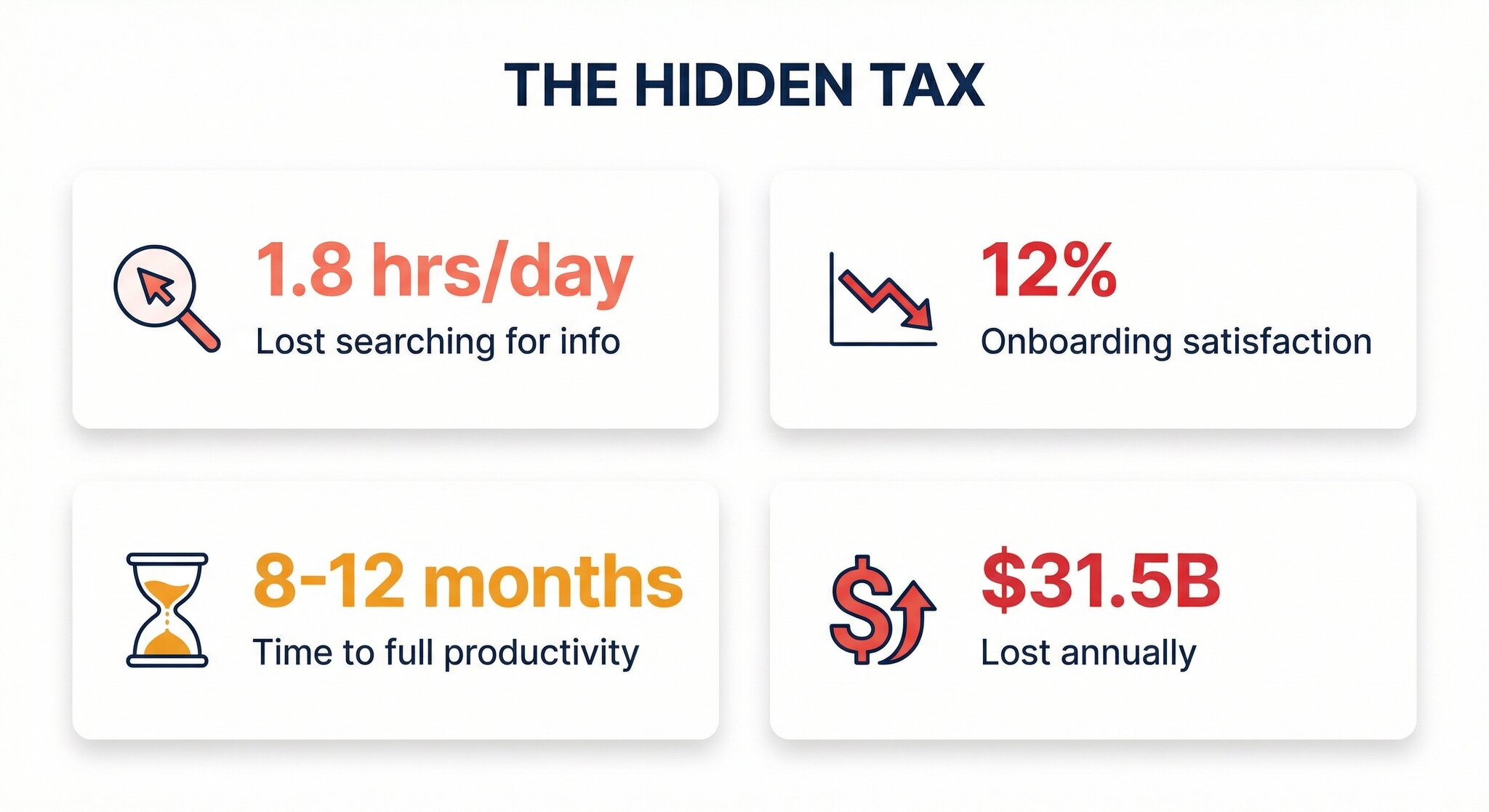
According to McKinsey, employees spend an average of 1.8 hours every day — nearly a quarter of their workweek — just searching for and gathering information. For new hires navigating unfamiliar systems, that number is almost certainly higher.
Meanwhile, only 12% of employees strongly agree their organization does onboarding well (Gallup). That means 88% of your workforce started their journey already struggling.
The Embarrassment Avoidance Loop
It takes new employees 8 to 12 months to reach full productivity (Brandon Hall Group). And according to IDC, Fortune 500 companies lose roughly $31.5 billion a year by failing to share knowledge effectively.
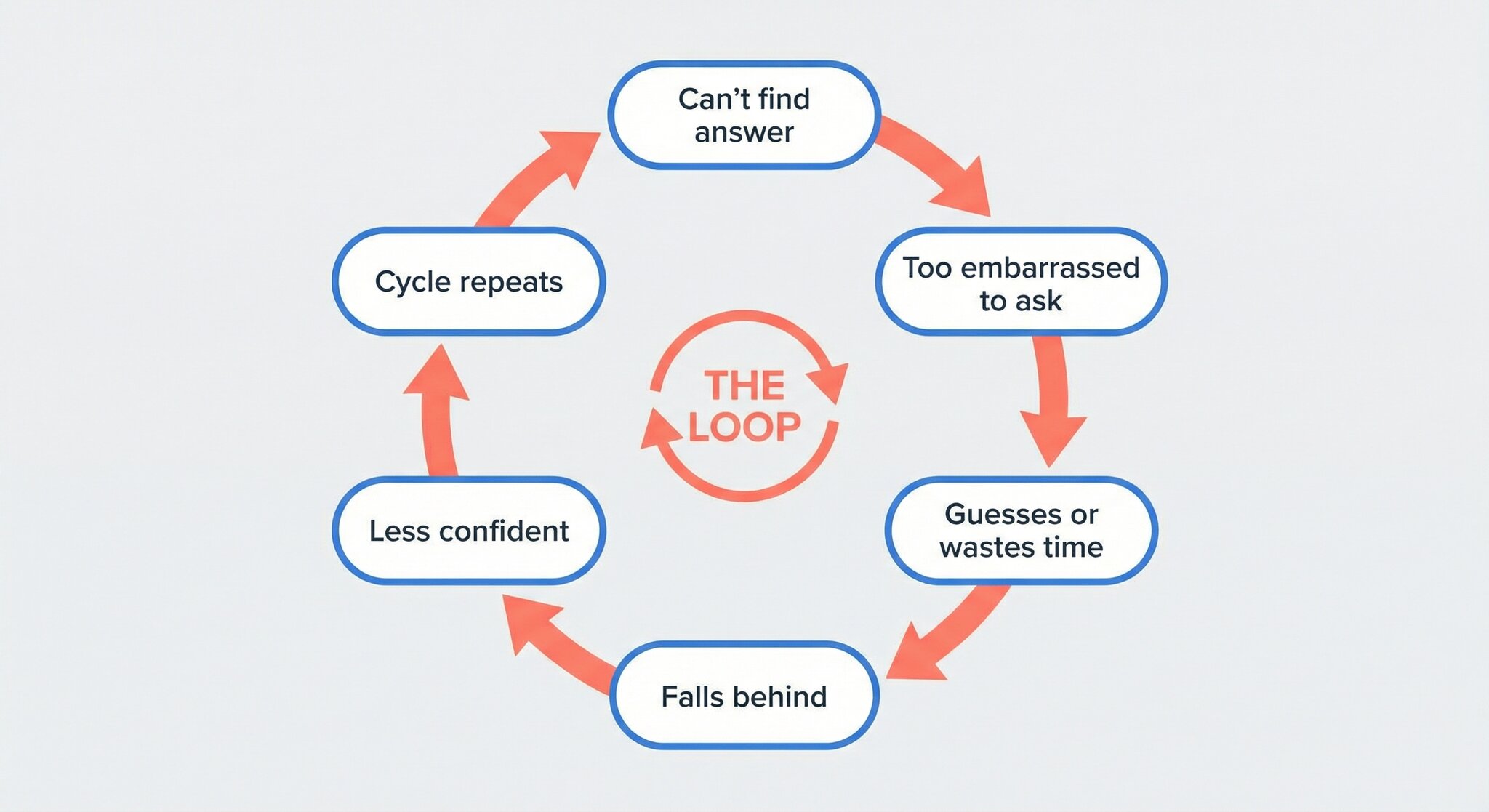
But here’s what the data doesn’t capture: the questions that never get asked.
Workplace psychology research consistently shows that new employees avoid asking questions to protect their professional image. They’d rather spend 30 minutes hunting through a document than risk appearing incompetent. This creates an embarrassment avoidance loop — the less they ask, the less they learn, and the longer it takes to become productive.
Why Traditional Employee Documents Fail
The problem isn’t that your documents contain bad information. It’s that the format itself works against how people actually learn.
No Feedback Loop
A static PDF has no idea whether someone understood what they read. There’s no check, no prompt, no moment of reflection. The reader scrolls, skims, and moves on — retaining a fraction of what they saw.
One Format Fits Nobody
People learn differently. Some need visuals. Some need to hear information. Some need to practice. A 47-page text document serves exactly one learning style — and even then, poorly. Yet 60% of workers end up seeking out their own training resources (EduMe) because the materials provided don’t meet their needs.
Context Collapse
Documents strip information of its context. A policy that makes perfect sense when explained by a colleague becomes cryptic in a PDF. Without tone, emphasis, or the ability to ask “wait, what does this mean?” — readers fill in the gaps themselves. Often incorrectly.
Three Principles from Learning Science That Fix This
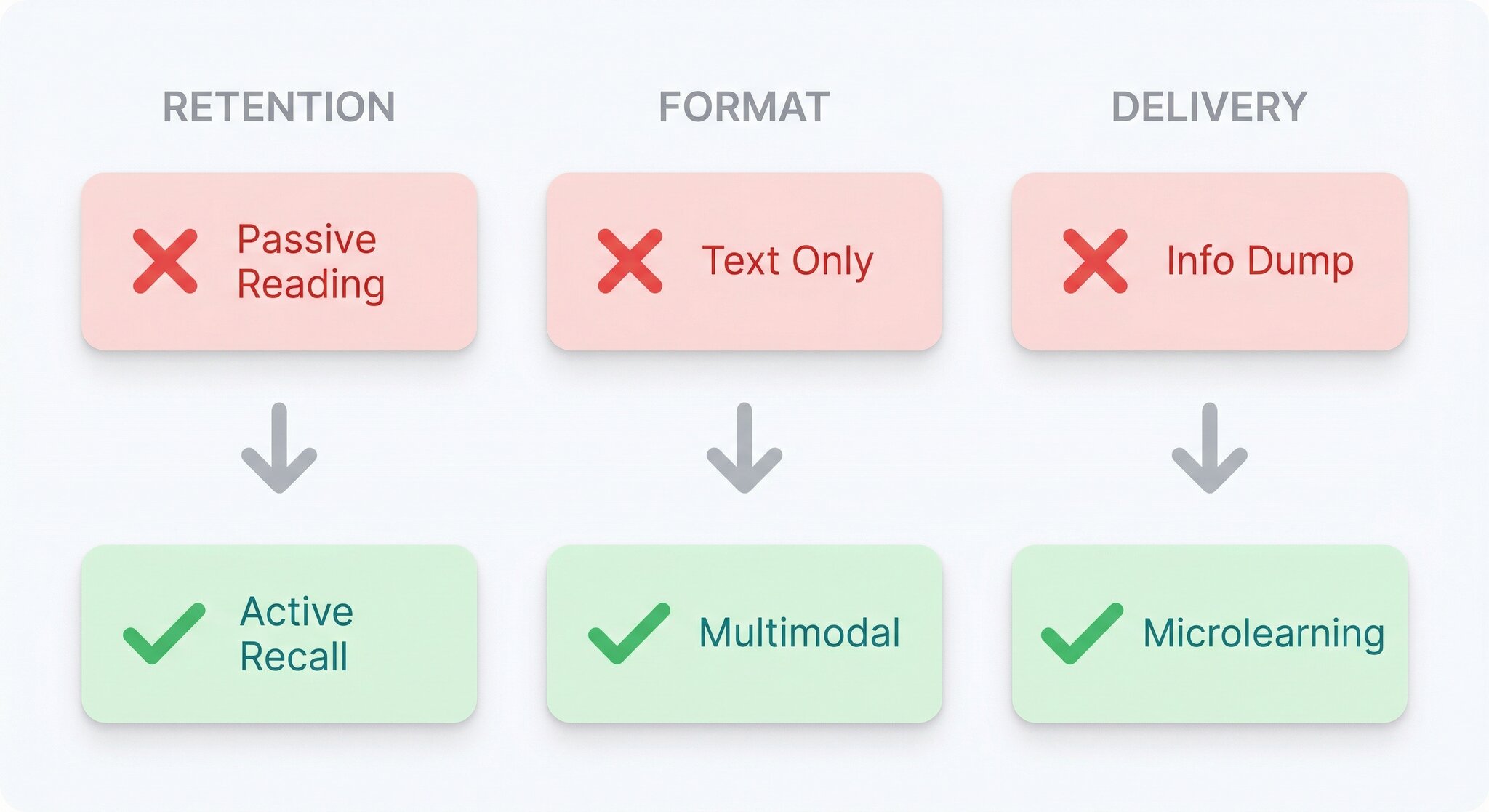
The good news: decades of research have already identified what works. The challenge is that most onboarding programs ignore it.
Active Recall Over Passive Reading
Roediger and Karpicke’s landmark 2006 study demonstrated that actively testing yourself on material produces significantly better long-term retention than simply re-reading it. This is the testing effect — and it’s one of the most replicated findings in cognitive science.
Static documents are pure passive consumption. No recall. No testing. No retention.
Multimodal Learning Over Text Walls
John Medina’s Brain Rules research found that when people hear information alone, they remember about 10% three days later. Add a relevant image, and retention jumps to 65%. Combining visual and verbal channels doesn’t just help — it transforms how much people retain.
A text-only PDF ignores this entirely.
Spaced Repetition Over Information Dumps
Research published in the Journal of Applied Psychology found that microlearning — delivering content in focused, bite-sized pieces — makes the transfer of learning 17% more efficient than traditional long-format training. Dumping 47 pages on someone’s first day is the opposite of this approach.
The Shift from Documents to Interactive Experiences
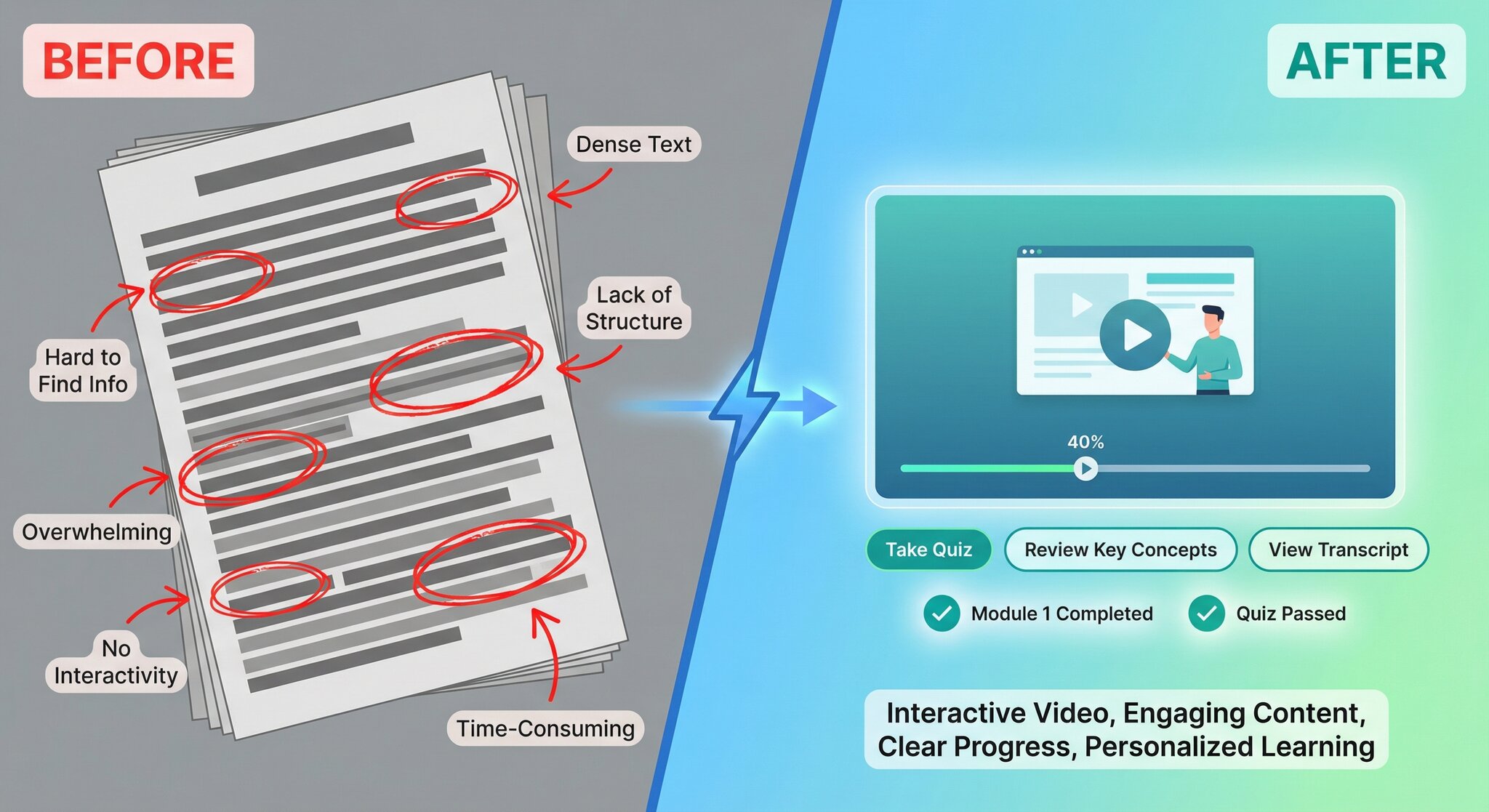
So what does it look like when you apply these principles to onboarding?
Instead of handing a new hire a PDF, imagine this:
- A short interactive video walks Priya through the expense policy — visually, with narration
- A quick comprehension check asks her to confirm she understood the key steps
- The content adapts based on her role, her department, her specific needs
- She can revisit any section at her own pace, without having to scroll through 46 irrelevant pages
This is the shift from static documents to an interactive onboarding experience. And with AI, this transformation doesn’t require months of instructional design. Existing documents can be converted into engaging, interactive video experiences — automatically.
What This Means for HR and L&D Teams
If you’re responsible for onboarding, training, or internal documentation, here’s where to start:
- Audit your existing documents. Which ones are critical for new hires? Which ones are collecting dust because nobody can navigate them?
- Prioritize interaction over information. The goal isn’t to give people more content. It’s to make sure they actually absorb what matters.
- Measure engagement, not just completion. A checkbox that says “read the handbook” tells you nothing. Comprehension checks and interaction data tell you everything.
- Reduce time-to-competence. Every month you shave off the 8–12 month ramp-up is a month of full productivity gained.
It Starts with the Documents You Already Have
You don’t need to rebuild your onboarding program from scratch. You need to transform the format.
The content is already there. The expertise is already captured. What’s missing is the bridge between your documents and your employees’ ability to actually learn from them.
Curious what your onboarding docs would look like as interactive experiences? Explore how Libertify transforms documents into engaging learning experiences.