AI Orchestration for Customer Success: The Complete Guide for CS Teams
Your CS team runs on twelve tools, five dashboards, and a prayer that nothing falls through the cracks. Customer health scores live in one platform. Support tickets in another. Onboarding workflows in a third. And somewhere between those systems, a high-value account quietly churns — because nobody connected the signals in time.
This is the problem AI orchestration for customer success solves. Not another point solution. Not another chatbot. A coordination layer that connects your AI agents, data streams, and customer touchpoints into a system that actually works together.
In this guide, we’ll break down exactly what AI orchestration means for CS teams, why 2026 is the year it becomes non-negotiable, and how to build an orchestration stack that reduces churn, scales your team’s impact, and transforms how customers experience your product.
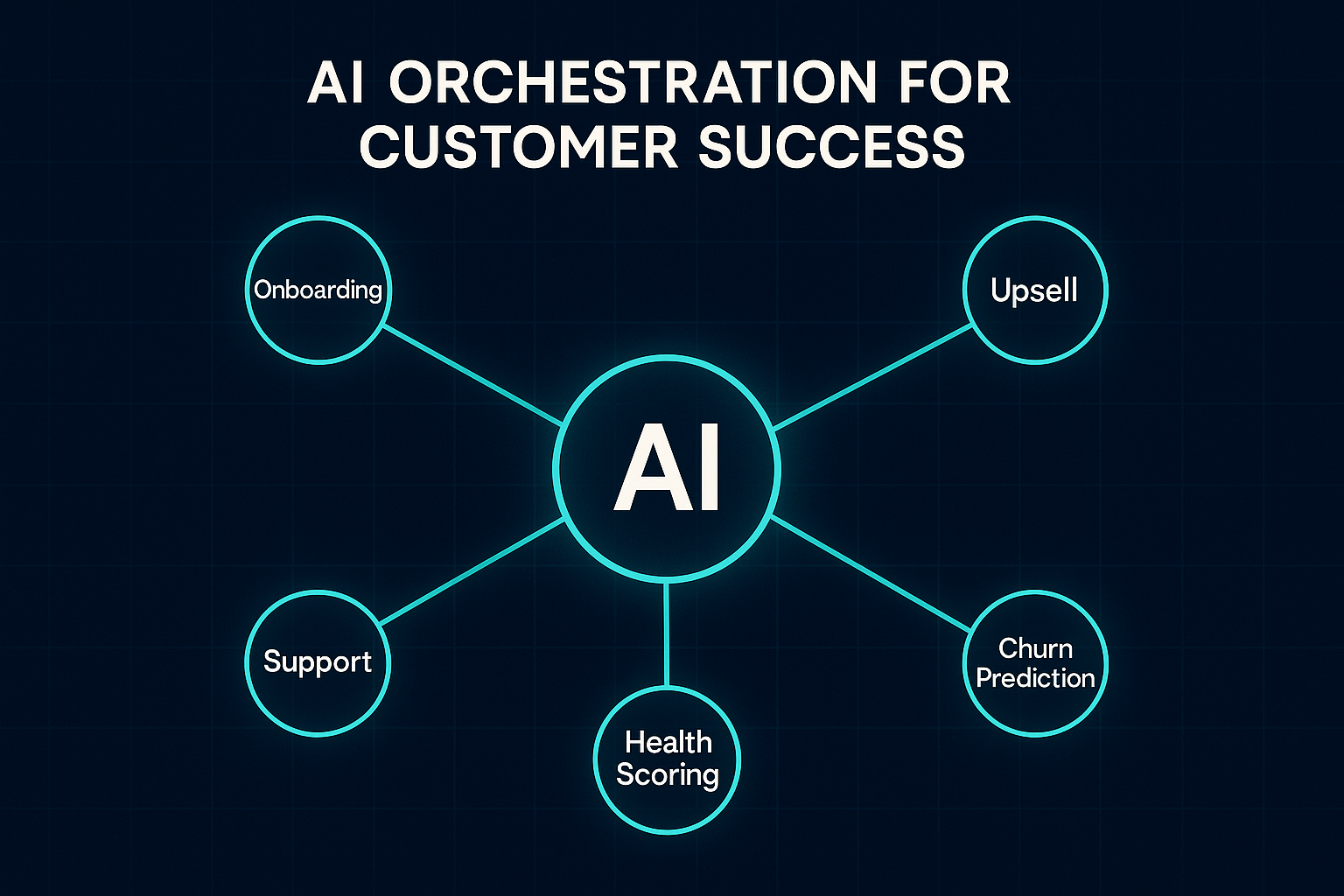
What Is AI Orchestration for Customer Success?
AI Orchestration Defined (and Why CS Teams Need It Now)
AI orchestration is the coordination layer that manages multiple AI agents, models, and automated workflows to deliver a unified customer experience. Think of it as the conductor of an orchestra: individual instruments (your AI tools) are powerful on their own, but without orchestration, you get noise instead of music.
For customer success teams specifically, AI orchestration connects the dots between:
- Customer data signals — product usage patterns, support interactions, NPS responses, billing changes
- AI-powered actions — churn predictions, automated playbooks, personalized outreach, content delivery
- Human judgment — CSM intervention for complex accounts, relationship-driven decisions, strategic escalations
Without orchestration, each of these operates in a silo. Your churn prediction model flags a risk, but the automated playbook doesn’t trigger. Your onboarding workflow sends the same generic sequence to a Fortune 500 account and a 10-person startup. Your CSM gets 47 alerts before lunch and ignores all of them.
AI orchestration for customer success eliminates these gaps by creating intelligent, coordinated workflows that route the right action to the right channel at the right time.
How AI Orchestration Differs from Basic Customer Success Automation
Here’s where most CS teams get stuck: they confuse automation with orchestration.
Automation is a single workflow: “If health score drops below 70, send an email.” It’s linear, rule-based, and operates within one tool.
Orchestration is the system that decides which automation to trigger, when to trigger it, who should be involved, and how to adapt based on real-time context. It’s multi-agent, multi-channel, and dynamic.
| Capability | Basic Automation | AI Orchestration |
|---|---|---|
| Trigger logic | Static rules (if/then) | Dynamic, context-aware AI decisions |
| Cross-tool coordination | Single platform | Multi-platform, multi-agent |
| Adaptation | Fixed sequences | Real-time adjustment based on outcomes |
| Human-AI handoff | Manual escalation | Intelligent routing with context preservation |
| Content delivery | Same asset to everyone | Personalized format and channel per segment |
The Multi-Agent Challenge: Why Tool Sprawl Is Killing CS Efficiency
The average B2B SaaS company uses 6-8 tools in their customer success stack. Each tool increasingly ships its own AI features — Gainsight has AI, ChurnZero has AI, your support platform has AI, your CRM has AI.
The result? Multiple AI agents making independent, sometimes contradictory decisions about the same customer. One system says expand, another says at-risk. One triggers a check-in email while another launches a survey. The customer receives three messages in two days from three different systems — and none of them acknowledge the support ticket they filed yesterday.
This is the multi-agent challenge, and it’s why AI orchestration has moved from “nice-to-have” to “critical infrastructure” for CS teams managing more than a few hundred accounts.
Why Customer Success Teams Are Adopting AI Orchestration in 2026
The Churn Problem — and How AI Orchestration Solves It
Customer churn remains the single biggest threat to SaaS economics. According to industry benchmarks, the median gross revenue churn for B2B SaaS sits between 10-14% annually, with some segments significantly higher. For a company with $50M ARR, that’s $5-7M walking out the door every year.
The painful truth: most churn is preventable. Studies consistently show that 70-80% of churned customers exhibited warning signals weeks or months before canceling. The problem isn’t detection — it’s coordination. CS teams see the signals but can’t act fast enough, consistently enough, or at sufficient scale.
AI orchestration attacks churn from three angles simultaneously:
- Signal aggregation — Pulling risk indicators from product analytics, support tickets, billing patterns, and engagement metrics into a unified view
- Intelligent triage — Prioritizing which accounts need human attention vs. automated intervention, based on account value, risk severity, and historical patterns
- Coordinated response — Triggering the right combination of actions (CSM outreach, automated content delivery, product experience changes, executive escalation) as a unified play, not disconnected tactics
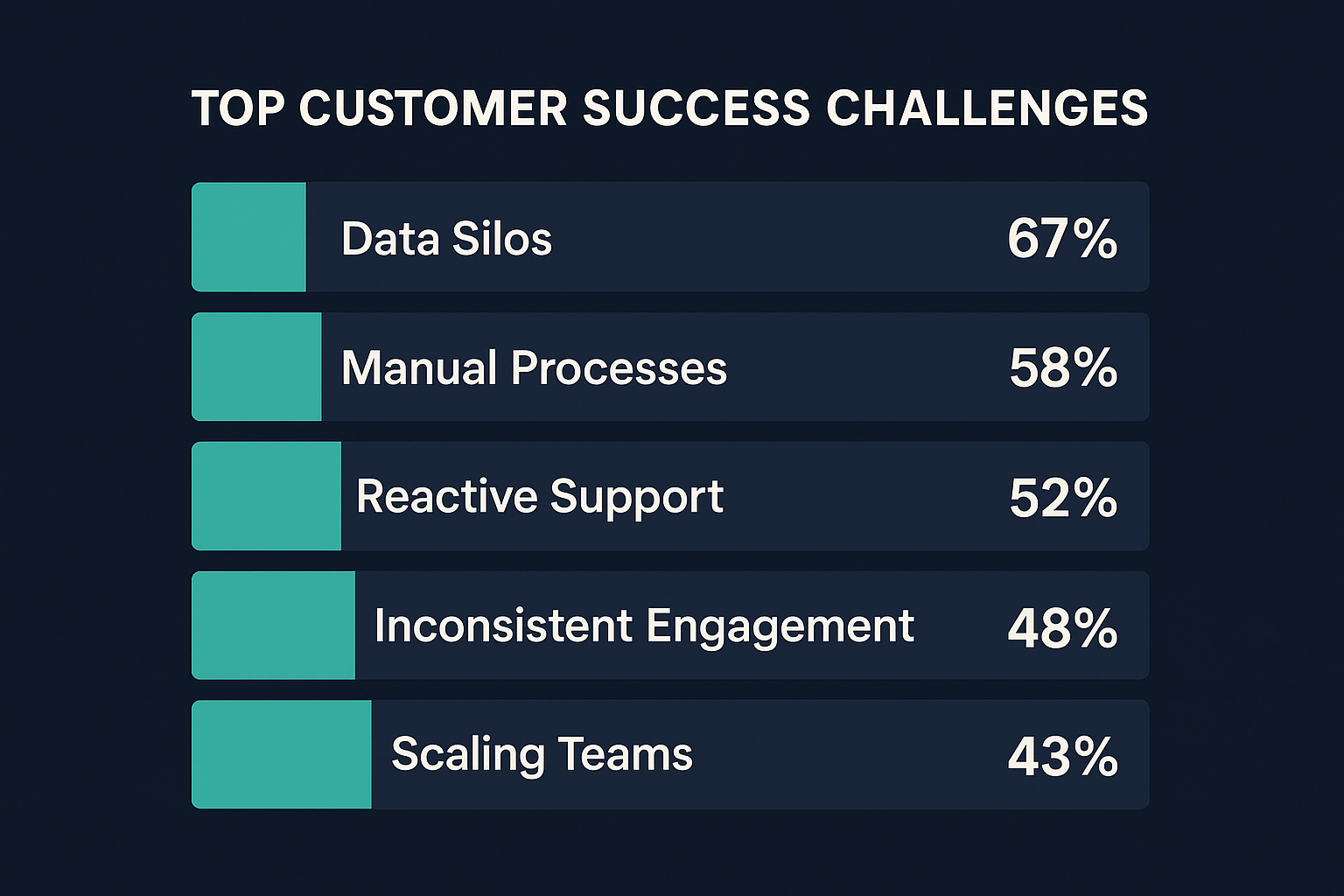
From Reactive Support to Proactive Customer Intelligence
Most CS teams still operate reactively. They respond to low health scores, react to support escalations, and scramble when a renewal is 30 days out with no engagement.
AI orchestration flips this model. Instead of waiting for signals to turn red, orchestrated systems:
- Predict which customers will need help before they ask — based on behavioral patterns across your entire customer base
- Prescribe specific actions for each account — not generic “check in” reminders, but context-rich playbooks tailored to the customer’s stage, segment, and behavior
- Pre-deliver resources proactively — sending the right onboarding content, product guide, or training material at the moment it’s most relevant
This shift from reactive to proactive is the single biggest operational improvement CS teams report after implementing AI orchestration. Teams consistently see 20-40% reductions in time-to-resolution and significant improvements in customer satisfaction scores.
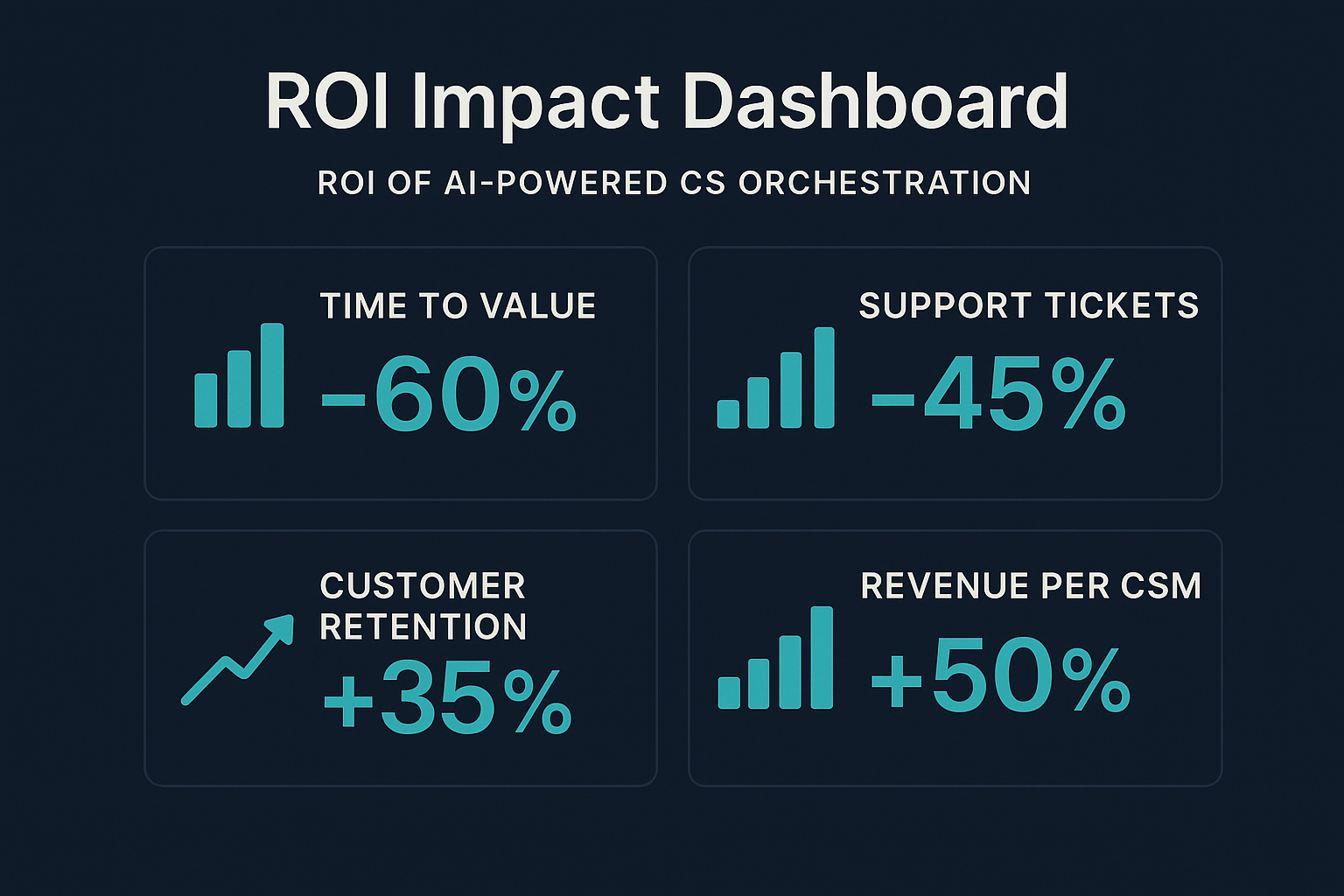
Key Stats: ROI of AI-Powered Customer Success Operations
The business case for AI orchestration in customer success is compelling:
- Churn reduction: Companies implementing coordinated AI across their CS stack report 15-30% reductions in gross churn within the first 12 months
- CSM productivity: AI-assisted orchestration enables CSMs to manage 2-3x more accounts without sacrificing quality of engagement
- Onboarding speed: Automated, orchestrated onboarding workflows reduce time-to-value by 30-50% compared to manual processes
- Net revenue retention: Organizations with mature AI orchestration consistently achieve NRR above 110%, driven by better expansion timing and reduced contraction
- Content engagement: Interactive, AI-delivered customer content sees 3-5x higher completion rates compared to static PDFs and documentation
The key insight: these results come not from any single AI tool, but from the orchestration layer that makes them work together.
7 Core Use Cases for AI Orchestration in Customer Success
1. Predictive Churn Detection and Automated Playbooks
The most mature AI orchestration use case in CS. Rather than relying on a single health score, orchestrated systems combine:
- Product usage decay patterns (login frequency, feature adoption depth, time-in-app trends)
- Support sentiment trajectory (not just ticket volume — the tone and complexity of interactions over time)
- Stakeholder engagement changes (champion departure, executive disengagement, buying committee shifts)
- External signals (company layoffs, M&A activity, leadership changes via news monitoring)
When the orchestration layer identifies a compound risk signal, it doesn’t just flag it — it triggers a coordinated playbook: CSM briefing with full context, automated outreach sequences adjusted to the risk type, executive sponsor alerts for strategic accounts, and content delivery tailored to re-engage the specific stakeholders going quiet.
2. AI-Driven Customer Health Scoring at Scale
Traditional health scores are backward-looking composites that update weekly (at best). AI-orchestrated health scoring is real-time, predictive, and multi-dimensional.
The orchestration layer continuously recalculates health across dimensions — product adoption, support experience, relationship strength, business fit, and contract trajectory — weighting each dimension based on what actually predicts outcomes for each customer segment. A startup in month two of onboarding gets scored very differently from an enterprise account approaching renewal.
3. Automated Onboarding Orchestration
Onboarding is where AI orchestration delivers the most immediately visible ROI. Instead of a linear email sequence that ignores whether the customer actually completed each step, orchestrated onboarding:
- Adapts the sequence based on real-time product adoption — skipping steps the customer has already completed, reinforcing areas where they’re stuck
- Switches channels dynamically — email for general updates, in-app guidance for feature adoption, interactive video experiences for complex workflows
- Escalates to human CSMs at the right moments — not on a schedule, but when behavioral signals indicate the customer is struggling or has high expansion potential
- Delivers personalized content formats — some customers prefer documentation, others learn better through video walkthroughs
4. Intelligent Expansion and Upsell Triggers
Expansion revenue is the engine of SaaS growth, and AI orchestration dramatically improves its timing and targeting. The orchestration layer identifies expansion-ready accounts by correlating:
- Feature usage approaching plan limits
- User growth patterns within the account
- Positive sentiment trends in support and product interactions
- Business context signals (funding rounds, hiring sprees, new product launches)
When these signals converge, the system orchestrates a multi-touch expansion play — equipping the CSM with a contextual briefing, triggering targeted content about relevant premium features, and (for high-potential accounts) looping in sales leadership with a warm introduction framework.
5. Multi-Channel Customer Communication Orchestration
Your customers interact with you across email, in-app messages, Slack channels, support portals, community forums, and live sessions. Without orchestration, each channel operates independently — leading to message fatigue, inconsistent information, and missed context.
AI orchestration creates a unified communication layer that:
- Tracks customer interactions across all channels to prevent over-communication
- Routes messages to the optimal channel based on the customer’s engagement patterns
- Maintains conversational context across channels (no more “as I mentioned in my email last week…”)
- Coordinates timing to respect the customer’s communication preferences and workload patterns
6. Document-to-Interactive-Experience Transformation
This is one of the most underutilized — yet highest-impact — applications of AI in the CS orchestration stack.
Customer success teams produce enormous volumes of static content: onboarding guides, QBR decks, product release notes, training documentation, knowledge base articles, best practice playbooks. The problem? Customers don’t engage with them. PDF completion rates hover around 15-20%. Long-form documentation gets skimmed at best.
AI-powered document transformation tools change this equation entirely by converting static content into interactive experiences:
- Onboarding documentation → guided, interactive video walkthroughs that new users actually complete
- Product release notes → engaging video summaries that drive feature adoption
- QBR presentations → personalized interactive experiences stakeholders can explore on their own time
- Knowledge base articles → searchable video libraries that reduce support ticket volume
- Training materials → interactive learning experiences with built-in comprehension checks
When integrated into your CS orchestration stack, document transformation becomes automated and contextual. The system identifies which customers need specific content, transforms it into the optimal format, and delivers it through the right channel at the right moment — without manual CSM effort.
👉 See how Libertify transforms customer-facing documents into interactive experiences. Explore Use Cases →
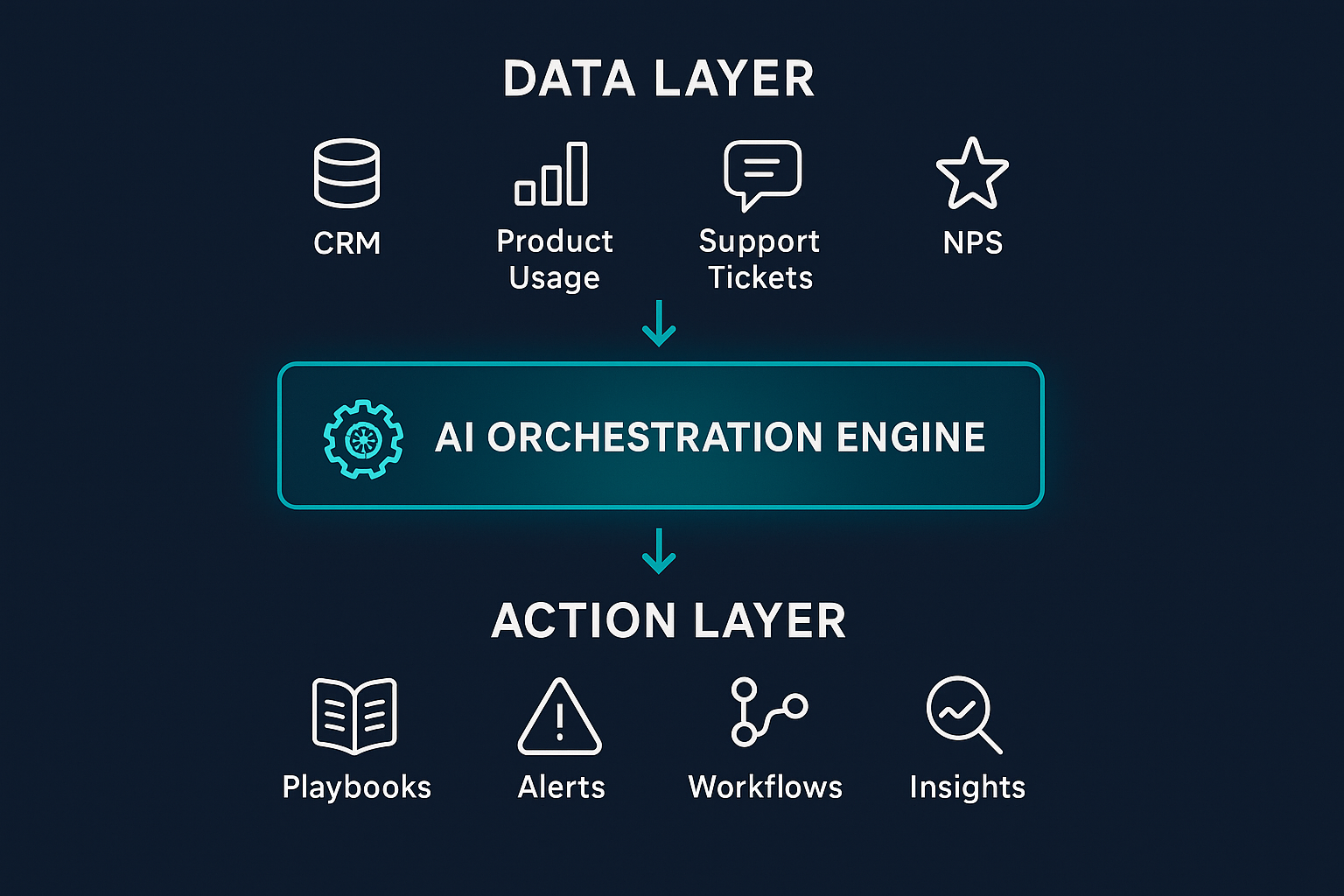
7. Real-Time Sentiment Analysis Across Touchpoints
Individual sentiment readings (a CSAT score here, a support ticket tone there) tell you very little. Orchestrated sentiment analysis aggregates signals across every touchpoint to build a real-time emotional profile for each account.
This means your AI orchestration layer can detect when an account’s overall sentiment is declining — even if no single interaction would trigger an alert on its own. A slightly shorter email response from the champion. A neutral (not positive) product review. A support ticket that’s technically resolved but carries frustration.
These micro-signals, invisible in isolation, become actionable when orchestrated together.
How to Build an AI Orchestration Stack for Your CS Team
Step 1 — Audit Your Current CS Tech Stack
Before adding orchestration, map what you have. Create a simple inventory:
- Data sources: Where does customer data live? (CRM, product analytics, support platform, billing system)
- AI capabilities: Which tools already have AI features? What do they predict or automate?
- Integration gaps: Where does data flow break? Which systems don’t talk to each other?
- Manual processes: What are your CSMs doing manually that could be orchestrated? (This is your biggest ROI opportunity.)
Most teams discover they have more AI capabilities than they realize — they’re just not connected.
Step 2 — Define Orchestration Goals and KPIs (NRR, CSAT, Churn Rate)
Don’t try to orchestrate everything at once. Pick one or two high-impact workflows to start:
- Churn prevention — Measure: gross churn rate reduction, save rate improvement
- Onboarding acceleration — Measure: time-to-value, onboarding completion rate, early churn reduction
- Expansion efficiency — Measure: NRR improvement, expansion pipeline generated by AI-triggered plays
- CSM productivity — Measure: accounts per CSM, proactive vs. reactive interaction ratio
Set baselines before implementation. You can’t prove ROI without a “before” number.
Step 3 — Choose Your AI Agents and Integration Layer
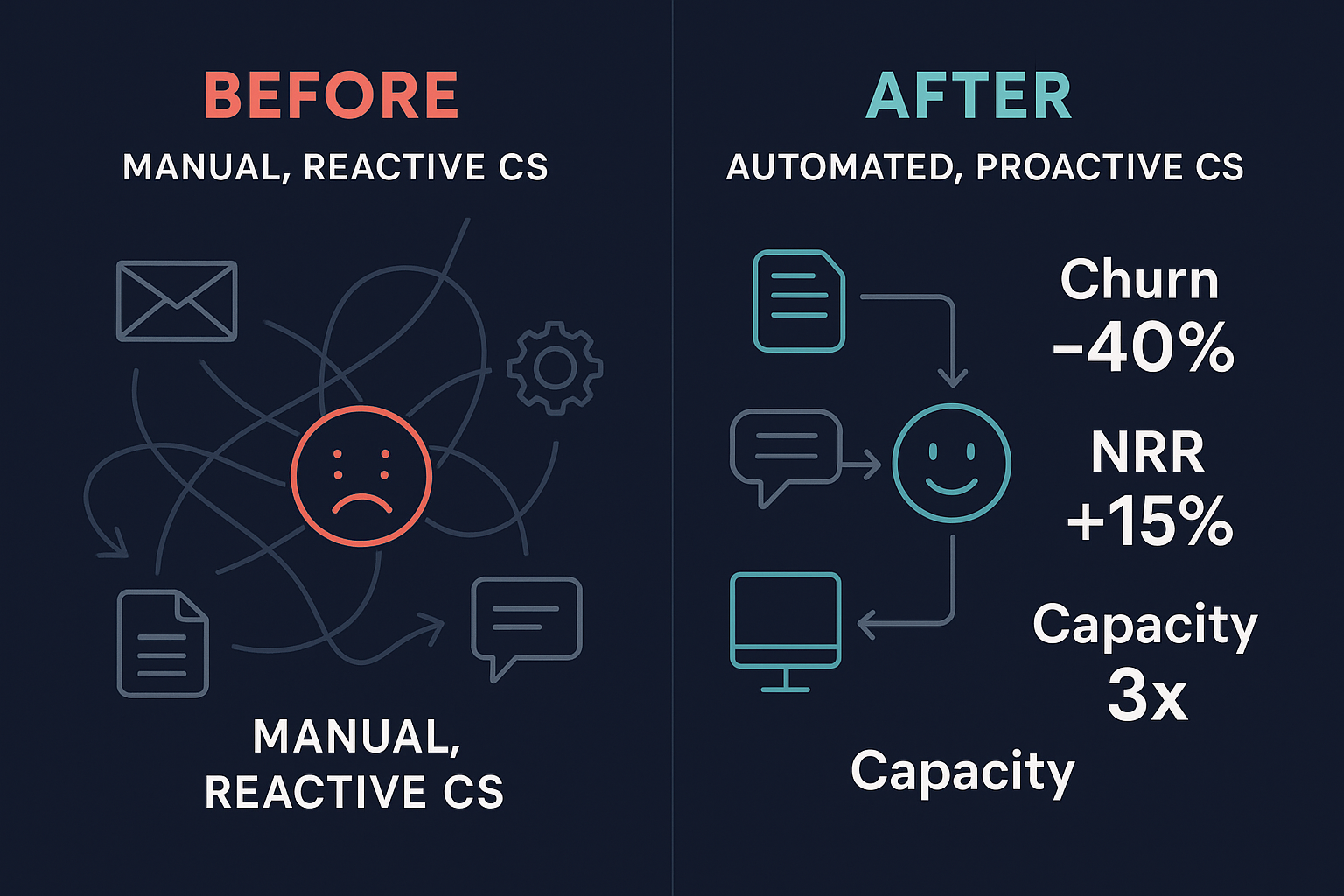
Your orchestration stack needs three layers:
- Data integration layer — A CDP or integration platform (Segment, RudderStack, or native integrations) that unifies customer data
- Orchestration engine — The intelligence layer that makes decisions across tools (this could be a dedicated platform like Gainsight, a workflow tool like n8n, or a custom solution)
- Action layer — The tools that execute: email automation, in-app messaging, interactive content delivery, CSM dashboards, and human notification systems
Step 4 — Design Automated Workflows with Human Escalation Points
The best AI orchestration systems know when not to automate. Design every workflow with explicit human-in-the-loop triggers:
- Tier 1 (Automated): Standard onboarding sequences, routine health check communications, content delivery, low-risk account actions
- Tier 2 (AI-Assisted): CSM receives AI-generated recommendations with full context — they approve, modify, or reject before execution
- Tier 3 (Human-Led): Strategic accounts, complex escalations, executive relationships — AI provides intelligence, humans drive the interaction
The automation/human ratio should shift based on account value. Your long-tail SMB accounts might be 80% automated. Your enterprise accounts might be 80% human-led with AI support.
Step 5 — Measure, Iterate, Scale
AI orchestration is not set-and-forget. Build a measurement cadence:
- Weekly: Review orchestration performance dashboards — action completion rates, customer response rates, CSM override frequency
- Monthly: Analyze outcome metrics — churn rate movement, NRR changes, onboarding velocity trends
- Quarterly: Full stack review — which orchestration workflows are driving results? Which need adjustment? What’s ready to scale?
Pay special attention to CSM override patterns. If your team is consistently overriding AI recommendations in a specific workflow, either the AI model needs retraining or the workflow design needs adjustment.
AI Customer Success Tools That Support Orchestration
Platform Comparison: Gainsight vs. ChurnZero vs. Vitally vs. Libertify
Each platform approaches AI orchestration from a different angle. Understanding their strengths helps you build the right stack:
| Platform | Core Strength | AI Orchestration Capability | Best For |
|---|---|---|---|
| Gainsight | Enterprise CS operations | Strong — native health scoring, playbooks, journey orchestration | Large CS teams (20+ CSMs) with complex account structures |
| ChurnZero | Real-time usage analytics | Growing — in-app engagement + automated plays | Product-led companies focused on usage-driven CS |
| Vitally | Modern CS workspace | Emerging — automations + integrations + project management | Fast-growing startups wanting all-in-one CS |
| Libertify | Document-to-experience transformation | Specialized — AI-powered content transformation and delivery | CS teams needing to scale interactive customer content |
The key insight: these aren’t competitors — they’re complementary layers in an orchestration stack. Gainsight or Vitally handles the customer data and workflow orchestration. Libertify transforms the content those workflows deliver. Your support platform handles the reactive channel. Together, they create a complete AI-orchestrated CS operation.
For current pricing across these platforms, most offer tiered plans based on account volume — budget $5-30 per managed account per month across your full stack.
What to Look for in an AI Orchestration Platform
When evaluating AI customer success tools for orchestration capability, prioritize:
- API-first architecture: Can it connect with your existing stack via robust APIs?
- Bi-directional data flow: Does it both consume and produce signals? (A tool that only reads data can’t participate in orchestration.)
- Configurable AI models: Can you tune predictions and recommendations for your specific customer segments?
- Human-in-the-loop support: Does it make it easy for CSMs to override, adjust, and provide feedback to the AI?
- Multi-channel output: Can it deliver actions across email, in-app, Slack, and content channels?
Turning Static Customer Documents into AI-Powered Experiences
Why Traditional PDFs and Reports Fail Your Customers
Let’s be honest about the state of customer success content. Most CS teams still deliver critical information through:
- PDF onboarding guides that run 20-40 pages
- Slide decks for QBRs that get forwarded (and ignored) by stakeholders who couldn’t attend
- Release notes buried in email threads
- Knowledge base articles that require customers to search, find, and read long-form text
The engagement data on these formats is brutal. Internal studies across B2B SaaS show PDF completion rates of 15-20%, email open rates for product updates declining year over year, and knowledge base articles averaging under 2 minutes of engagement regardless of length.
Your CS team is creating valuable content. Your customers just aren’t consuming it. That’s not a content quality problem — it’s a format and delivery problem.
How AI Transforms Customer Success Deliverables into Interactive Content
AI-powered document transformation addresses this by meeting customers where modern attention patterns actually are: interactive, visual, self-paced experiences.
The transformation process works like this:
- Input: Upload existing CS content — onboarding docs, product guides, QBR decks, training materials
- AI Processing: The platform analyzes content structure, extracts key concepts, and generates an interactive experience with visual elements, narration, and engagement checkpoints
- Output: A shareable, trackable interactive experience that customers can consume at their own pace
- Analytics: Detailed engagement data — who watched, how far they got, what they replayed, where they dropped off
When this capability is integrated into your orchestration stack, the transformation happens automatically. Your orchestration engine identifies that a customer needs specific content, triggers the transformation, and delivers the interactive experience through the optimal channel — all without manual CSM involvement.
Case Study: From Customer Report to Personalized Video Experience
Consider a typical scenario: Your CS team produces quarterly business reviews for your top 200 accounts. Each QBR is a 15-slide deck with usage data, ROI metrics, and strategic recommendations.
Before orchestration: A CSM spends 2-3 hours personalizing each deck. They schedule a 30-minute call. Half the stakeholders don’t attend. The deck gets emailed to absentees who never open it. Total stakeholder engagement: maybe 30%.
After AI orchestration: The system automatically pulls account data into a QBR template. An AI transformation tool converts it into a personalized interactive experience. The orchestration layer delivers it to every stakeholder via their preferred channel, with follow-up triggers based on engagement. Stakeholders watch on their own time, replay the sections relevant to them, and the system alerts the CSM when a stakeholder engages deeply with the ROI section (expansion signal). Total stakeholder engagement: 70-85%.
The CSM’s time drops from 2-3 hours per QBR to 15-20 minutes of review and personalization. Multiply that across 200 accounts and you’ve reclaimed hundreds of CSM hours per quarter.
Common Mistakes When Implementing AI Orchestration for CS
Over-Automating Without Human Oversight
The most common (and most damaging) mistake: letting AI run everything without human guardrails. A churn prediction model that’s 85% accurate sounds great — until you realize the 15% false positives are getting aggressive “win-back” campaigns when they’re actually happy customers.
Build human oversight into every high-stakes workflow. For strategic accounts, AI should recommend, not execute. The orchestration layer’s value isn’t replacing CSMs — it’s giving them superpowers by handling routine decisions while surfacing the ones that need human judgment.
Alert Fatigue — and How to Prevent It
Poor orchestration is worse than no orchestration. If your system generates 50 alerts per CSM per day, they’ll ignore all of them — including the one that matters.
Prevention strategies:
- Alert budgets: Cap the number of alerts per CSM per day. Force the orchestration layer to prioritize.
- Composite signals: Don’t alert on individual data points. Alert on patterns — combinations of signals that together indicate a meaningful change.
- Action-oriented alerts: Every alert should include a recommended action with full context. “Account X is at risk” is useless. “Account X shows declining usage in your core module, their champion hasn’t logged in for 14 days, and renewal is in 60 days — here’s the recommended play” is actionable.
Ignoring Data Quality Before Deploying AI
AI orchestration is only as good as the data flowing through it. Before you deploy, audit your data foundations:
- Are customer records consistently maintained across systems?
- Is product usage data accurate and complete?
- Are support interactions properly categorized and sentiment-tagged?
- Do you have reliable stakeholder mapping for your accounts?
Most teams discover significant data quality issues during this audit. Fix them first. An AI orchestration engine running on dirty data will confidently make wrong decisions at scale — which is worse than making no decisions at all.
The Future of AI Orchestration in Customer Success
Agentic AI and Autonomous CS Operations
The next evolution of AI orchestration is agentic AI — autonomous agents that don’t just follow orchestrated workflows but actively plan, execute, and adapt strategies for each account.
In practice, this means an AI agent that can independently:
- Analyze an account’s current state across all data sources
- Develop a tailored engagement strategy based on the account’s goals, behavior patterns, and historical outcomes from similar accounts
- Execute multi-step plans — scheduling content delivery, initiating outreach, booking meetings, creating personalized resources
- Learn from outcomes and adjust future strategies
We’re in the early innings of this shift, but the direction is clear. CS teams that build their orchestration foundations now will be positioned to adopt agentic capabilities as they mature.
For the latest thinking on where this technology is heading, explore our AI insights and analysis.
How LLMs Are Changing Customer Success Communication
Large language models are transforming every communication touchpoint in the CS workflow:
- Email personalization: AI-generated outreach that’s contextual, natural, and specific to each account’s situation — not template-based mail merge
- Meeting preparation: LLMs that synthesize all account data into a briefing document before every customer call
- Content generation: Automated creation of personalized product guides, success plans, and business reviews
- Conversation intelligence: Real-time analysis of customer calls with recommended next actions delivered before the meeting ends
The orchestration layer’s role here is crucial: ensuring these LLM-powered capabilities operate consistently, use accurate data, and align with the overall account strategy rather than optimizing each interaction in isolation.
Predictions for 2026-2027
Based on current trajectories and emerging technology capabilities:
- Orchestration becomes table stakes: By mid-2027, CS teams without an orchestration layer will be unable to compete for talent or retain customers at scale. It becomes like CRM — you can’t run CS without it.
- Content format shifts dramatically: Static documents will decline sharply in CS workflows, replaced by AI-generated interactive experiences that adapt to each customer’s context and learning style.
- CSM roles elevate: With AI handling routine orchestration, CSMs become strategic advisors focused exclusively on high-value relationship building, complex problem solving, and expansion strategy.
- Vendor consolidation: Expect 2-3 major acquisitions as CS platforms acquire AI orchestration capabilities — the stand-alone tool era for CS is ending.
- Measurability improves: AI orchestration will finally deliver on the promise of attributing retention and expansion revenue to specific CS actions and content — enabling true ROI measurement for customer success teams.
Build Your AI Orchestration Advantage Now
AI orchestration for customer success isn’t a future concept — it’s the operational model that separates scaling CS teams from struggling ones. The companies building their orchestration stack today will compound their advantages over the next 2-3 years while competitors are still stitching together disconnected automations.
Start with the framework we outlined: audit your stack, define your goals, choose your layers, design human-AI workflows, and measure relentlessly. And don’t overlook the content delivery layer — transforming how customers experience your documentation and resources is one of the highest-ROI moves in the entire orchestration stack.
The window for building competitive advantage through AI orchestration is open now. It won’t stay open forever.
Transform Your Customer Success Content
Turn static docs into interactive experiences your customers actually engage with.
FAQ — AI Orchestration Customer Success
What is AI orchestration in customer success?
AI orchestration in customer success is the coordination layer that connects multiple AI tools, data sources, and automated workflows to deliver unified, proactive customer experiences at scale. Unlike basic automation (single if/then rules), orchestration manages the interplay between multiple AI agents — deciding which actions to trigger, when, through which channels, and whether to involve a human CSM. It’s the system that ensures your churn prediction, onboarding automation, content delivery, and communication tools work together rather than in silos.
How does AI orchestration reduce customer churn?
AI orchestration reduces churn by aggregating risk signals from across your entire tech stack — product usage, support interactions, billing patterns, engagement metrics — and triggering coordinated retention plays before customers reach the point of no return. Instead of a single health score alert, orchestration deploys a multi-touch response: CSM outreach with full context, automated content delivery addressing the specific pain point, adjusted communication cadence, and executive escalation when needed. Companies typically see 15-30% churn reduction within the first year of implementing orchestrated AI.
What’s the difference between AI automation and AI orchestration?
Automation executes a predefined action when a trigger occurs: “If health score drops below 70, send email.” It’s single-tool, linear, and rule-based. Orchestration is the intelligence layer that coordinates multiple automations across tools: it decides which action to take, when to take it, through which channel, and whether the situation requires AI-only handling or human involvement. Think of automation as a single musician playing their part, and orchestration as the conductor ensuring the entire ensemble performs together.
What tools support AI orchestration for CS teams?
The AI orchestration stack for CS typically includes: a customer success platform for workflow orchestration (Gainsight, ChurnZero, Vitally), a data integration layer (Segment, RudderStack), communication tools (Intercom, Drift), content transformation platforms like Libertify for turning static documents into interactive experiences, and analytics tools for measuring outcomes. The key is choosing tools with strong APIs that enable bi-directional data flow — the orchestration layer needs tools that both consume and produce signals.
How much does AI orchestration cost to implement?
Costs vary widely based on your stack complexity and account volume. Budget ranges: $5-15 per managed account per month for a basic orchestration stack (CS platform + integrations + one AI tool), scaling to $20-40 per account for enterprise implementations with multiple AI agents, custom models, and advanced analytics. Most teams see positive ROI within 6-9 months through churn reduction and CSM productivity gains. Start with a focused pilot (one orchestrated workflow, 100-200 accounts) to prove ROI before scaling investment.
How should CS teams get started with AI orchestration?
Start with a tech stack audit: map every tool, data source, and manual process in your CS workflow. Identify the one or two workflows where disconnected tools cause the most pain — usually churn prevention or onboarding. Build your first orchestrated workflow connecting 2-3 existing tools with a clear KPI. Measure for 60-90 days, iterate based on results, then expand to additional workflows. The biggest mistake is trying to orchestrate everything at once. Pick your highest-ROI workflow and nail it first.
What is agentic AI in customer success?
Agentic AI represents the next evolution beyond orchestration — autonomous AI agents that can independently plan, execute, and adapt customer success strategies. While current orchestration follows human-designed workflows, agentic AI can analyze an account’s situation, develop a tailored engagement plan, execute multi-step actions, and learn from outcomes to improve future strategies. This technology is emerging rapidly, and CS teams building strong orchestration foundations today will be best positioned to adopt agentic capabilities as they mature over 2026-2027.