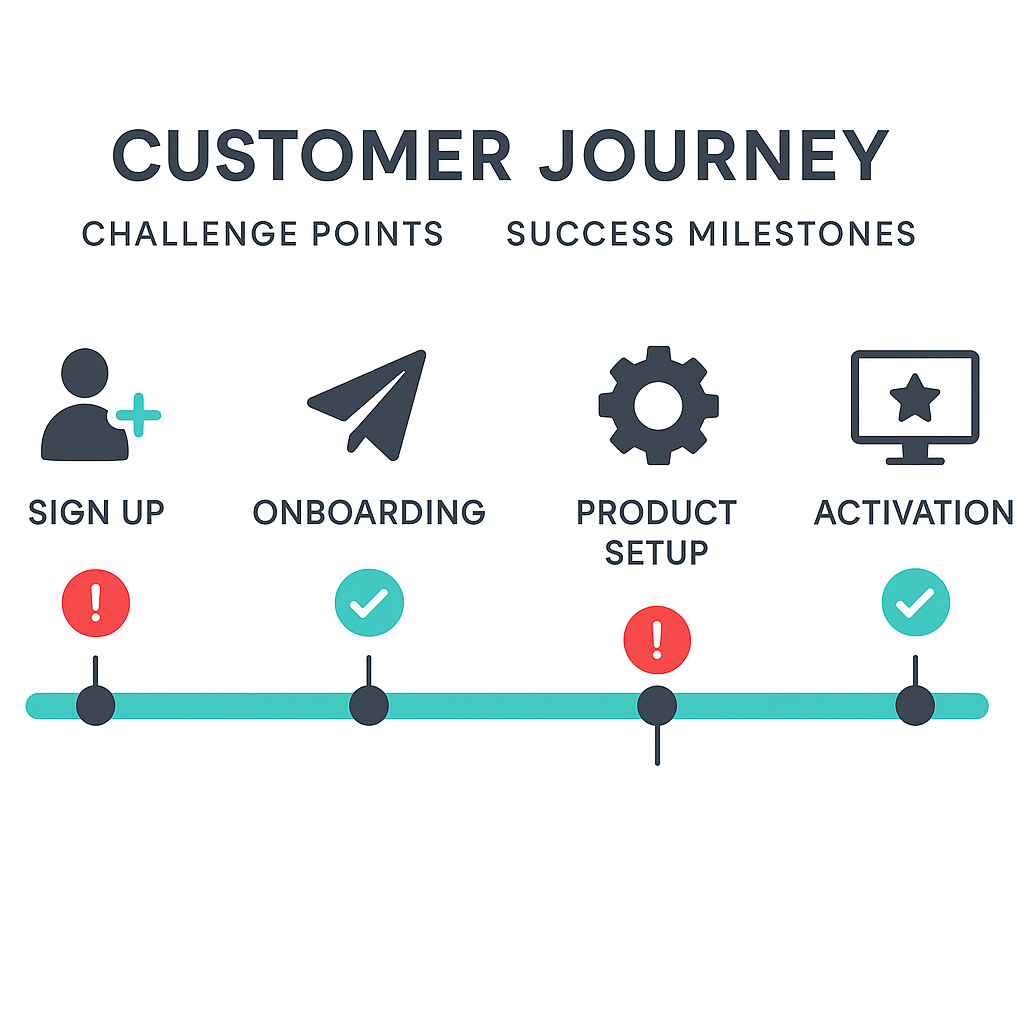
Customer Onboarding Challenges: 7 Critical Issues CS Teams Must Solve
Customer onboarding challenges are the silent killers of SaaS growth, with 63% of customers citing poor onboarding as their primary reason for churning within the first 90 days. For customer success professionals, these challenges represent both the biggest threat to retention and the greatest opportunity for revenue expansion.
Recent studies by PwC reveal that companies with exceptional onboarding processes achieve 2.5x higher customer lifetime value and 50% better net revenue retention. Yet most CS teams struggle with outdated onboarding approaches that fail to address modern customer expectations for self-service, personalization, and rapid time-to-value.
The Evolution of Customer Onboarding Challenges
Traditional onboarding relied on linear, one-size-fits-all processes that worked when software adoption was simpler. Today’s the biggestchallenges reflect fundamental shifts in buyer behavior:
Self-service expectations from digital-native users
Multi-stakeholder decision making in B2B purchases
Shortened trial periods requiring faster value demonstration
Complex integration requirements with existing tech stacks
The complexity multiplies for CS teams managing hundreds or thousands of customers simultaneously. Manual onboarding approaches that worked for 50 customers become impossible at 500, creating systematic bottlenecks that impact the entire customer lifecycle.
Critical Customer Onboarding Challenges Facing CS Teams
1. Time-to-Value Optimization Pressure
The most persistent challenge involves demonstrating value before customers lose interest:
Executive stakeholders expect ROI proof within 30-45 days
End users need immediate productivity gains to justify adoption
Technical teams require seamless integration with minimal disruption
Procurement departments track utilization metrics from day one
2. Personalization at Scale
Modern customers expect onboarding experiences tailored to their specific use cases, but these challenges emerge when trying to personalize for hundreds of different scenarios:
Industry-specific workflows that require custom configuration
Company size variations demanding different complexity levels
Continuous improvement processes based on customer feedback
Executive sponsorship for onboarding transformation initiatives
Building Your Onboarding Challenge Resolution Framework
Assessment and Planning Phase
Begin addressing your challenges with comprehensive analysis:
Audit existing onboarding processes for bottlenecks and friction
Survey churned customers to understand onboarding failures
Analyze successful onboarding patterns for replication opportunities
Benchmark against industry standards for performance targets
Implementation Strategy
Execute systematic solutions for your specific customer onboarding challenges:
Pilot new approaches with controlled customer groups
Measure impact using leading and lagging indicators
Iterate based on results before full-scale implementation
Train CS teams on new processes and tools
Conclusion: Transforming Onboarding Challenges into Competitive Advantages
Customer onboarding challenges represent both the greatest risk and opportunity for CS teams in 2024. Organizations that systematically address these challenges through data-driven analysis, automation, and customer-centric design create sustainable competitive advantages.
The key lies in treating onboarding as a strategic capability, not just an operational process. By investing in proper tools, processes, and team expertise, CS professionals can transform onboarding from a cost center into a growth driver that accelerates expansion revenue and reduces churn.
Ready to solve your onboarding challenges? Discover how Libertify’s customer success automation platform helps CS teams scale onboarding without sacrificing personalization.