AI for higher education has moved from pilot to infrastructure faster than most institutions expected. According to Microsoft’s 2025 AI in Education report, 86% of education organisations now use generative AI, primarily for personalized teaching and simplifying administrative processes. Furthermore, the global AI in education market is forecast to grow from USD 5.88 billion in 2024 to USD 32.27 billion by 2030, according to Grand View Research. Every major university is building an AI stack, and the tools available in 2026 are genuinely capable.
However, a consistent gap runs through nearly every AI for higher education implementation today. Institutions have AI that helps students generate content, AI that helps faculty create lesson plans, AI that automates admissions and student support, and AI that personalizes learning pathways. What they do not have is AI that tells educators what students actually understood from the documents, case studies, and course materials they were assigned. That missing layer is where most learning outcomes quietly break down, and it is what this post covers.
What AI for higher education actually covers in 2026
The current AI for higher education landscape divides into four categories, each well-served by existing tools.
First, general-purpose AI assistants. ChatGPT for Teachers, Claude for Education, and Gemini for Education give faculty and students a capable writing, research, and problem-solving partner inside familiar interfaces. These tools are the foundation of most institutional AI stacks in 2026 and handle the broadest range of everyday tasks.
Second, lesson planning and curriculum tools. Platforms like Brisk Teaching help faculty turn syllabus topics into structured lesson outlines, generate differentiated materials for mixed-ability cohorts, and rewrite dense content at multiple reading levels. Consequently, these tools reduce preparation time significantly for teaching staff.
Third, assessment and evaluation engines. AI assessment tools grade open-ended answers, flag academic integrity concerns, and surface at-risk students before they fall through the cracks. Notably, these tools improve the speed and consistency of evaluation across large cohorts.
Fourth, administrative automation. Chatbots, automated advising tools, and AI-powered ticketing systems handle repetitive student queries around the clock, freeing staff for higher-value interactions. As a result, institutions report significant reductions in administrative workload after deploying these tools.
Together, these four categories cover creation, automation, assessment, and student support. What they do not cover is comprehension. Specifically, none of them tell educators what students understood from a course document after they read it.
The comprehension gap in AI for higher education
Consider what happens when an educator assigns a dense policy brief, a financial case study, or a regulatory framework document to a cohort of students. The LMS records who opened it and how long they spent on the page. A follow-up quiz tests a predetermined set of facts. Beyond that, the educator has no visibility into which sections confused students, what questions formed in their minds but never made it to the discussion board, or which parts of the document nobody engaged with at all.
Furthermore, the students who struggled most are often the least likely to raise their hand. They click through the material, close the tab, and carry their confusion into the assessment. By then, the window for intervention has passed.
This is the comprehension gap that AI for higher education has not yet closed. Completion data proves a document was opened. Quiz scores test a narrow slice of recall. Neither tells an educator what the cohort genuinely understood at the section level, or which students need a follow-up conversation before the next class.
Why comprehension analytics matter for higher education institutions
For institutions like SKEMA Business School and the Hong Kong Institute of Bankers, where course materials carry direct professional and regulatory relevance, the comprehension gap is not just a pedagogical concern. It is a reputational and compliance concern. Graduates who completed a course but did not understand the material represent a risk for the institution and for the industries that hire them.
Moreover, AI for higher education that stops at completion is increasingly difficult to defend to accreditation bodies that expect evidence of learning outcomes. Completion rates prove students attended. Comprehension analytics prove they learned. That distinction matters at the institutional level in ways that a quiz score alone cannot satisfy.
How Libertify fills the comprehension gap in AI for higher education
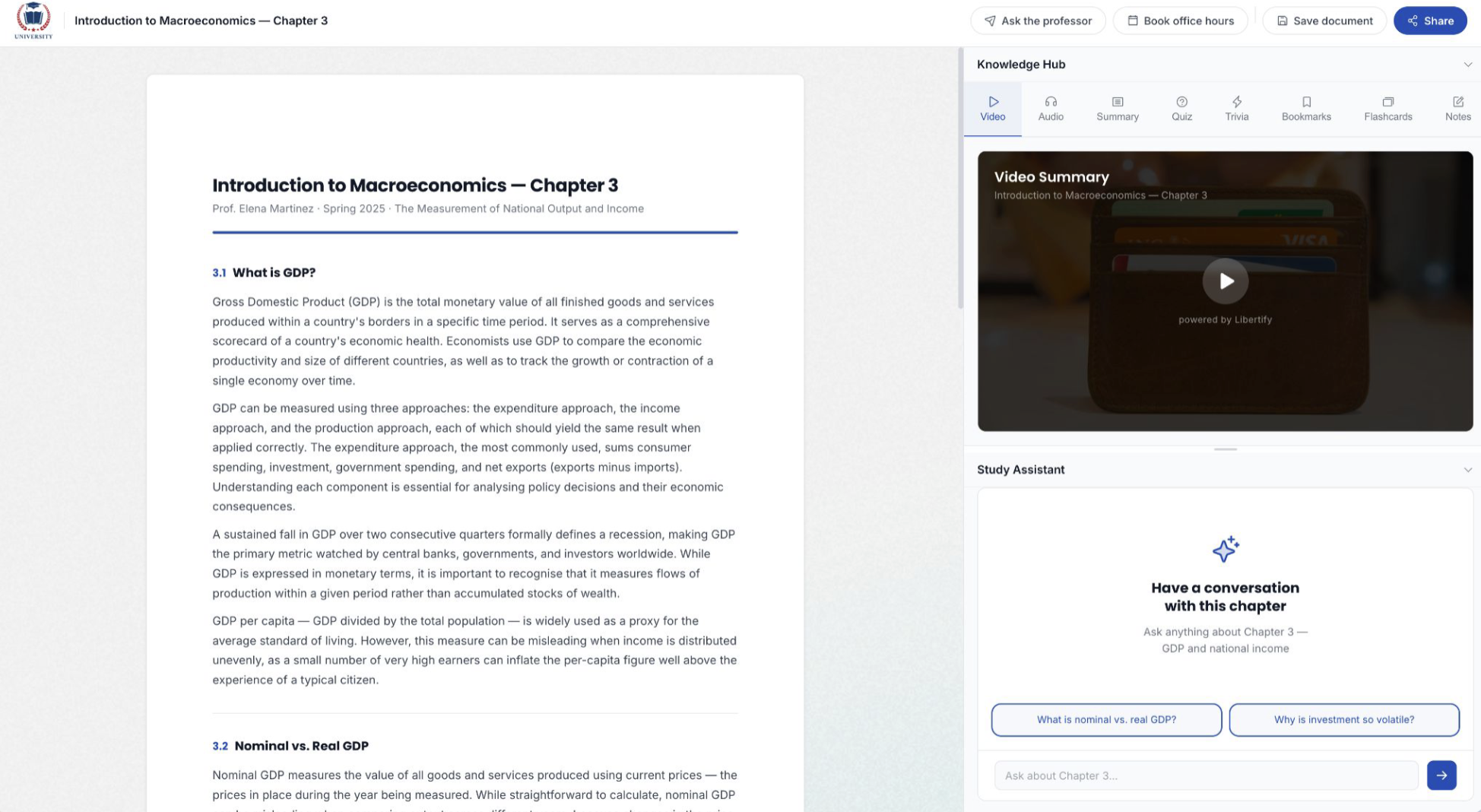
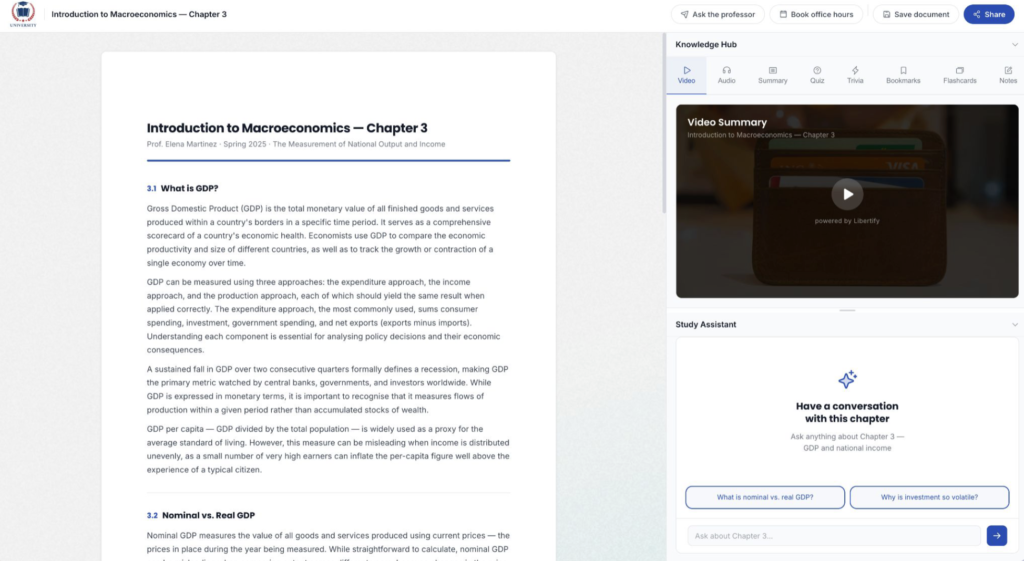
Libertify sits on top of any PDF, PowerPoint, or Word document an institution already uses as course material. It transforms each document into a guided learning experience with an AI assistant grounded strictly in the document content, with no information outside the assigned material and no hallucinations. Students engage with the material at their own pace, asking questions and working through sections with AI support tailored to the document itself.
As students work through the material, Libertify generates comprehension signals for educators: which sections each student re-read, which they skipped, what questions they asked, and where understanding broke down at the cohort level. Furthermore, it converts those signals into a specific action: which students need a follow-up session, which sections of the document need to be rewritten for clarity, and which comprehension gaps to address before the next assessment.
The result is AI for higher education that closes the loop between content delivery and confirmed understanding. Today, institutions including SKEMA Business School and the Hong Kong Institute of Bankers use Libertify specifically because the documents they assign carry direct professional consequence. Explore how it works across education and training workflows at libertify.com/use-cases/, and see real outcomes in the Libertify success stories.
Frequently asked questions
What is AI for higher education?
AI for higher education refers to the use of artificial intelligence tools across university and professional education environments. In 2026 this covers general-purpose assistants for students and faculty, lesson planning and curriculum tools, AI-powered assessment engines, and administrative automation. The emerging frontier is comprehension analytics: AI that measures what students actually understood from assigned materials, not just whether they completed them.
What is the most widely used AI in higher education in 2026?
General-purpose assistants such as ChatGPT for Teachers, Claude for Education, and Gemini for Education form the foundation of most institutional AI stacks in 2026. Assessment platforms and administrative chatbots follow. Comprehension analytics tools represent the next generation of AI for higher education adoption.
How does AI improve student learning outcomes in higher education?
AI improves learning outcomes by personalising content, providing on-demand support, and automating feedback cycles. However, the most significant improvement comes from closing the comprehension gap: identifying which students did not understand assigned materials before they reach an assessment, rather than after.
What is the difference between AI learning analytics and comprehension analytics?
Learning analytics typically covers activity data: logins, time-on-platform, completion rates, and grade distributions. Comprehension analytics goes further, capturing what students understood from specific materials, what questions they formed, and which sections need to be revised or reinforced.
How can higher education institutions measure whether students understood course materials?
Standard measurement relies on quiz scores and class participation. Comprehension analytics tools like Libertify add a layer between content delivery and assessment, capturing engagement signals at the section level and surfacing the specific students and content areas that need attention before the next class.
Make your course materials understood, not just completed
Upload any course document to Libertify and generate your first comprehension signals in about three minutes. Make documents understood. Start with Libertify →