
Last updated: February 20, 2026
You’ve been told that 75% of resumes get rejected by robots before a human ever sees them. That statistic has been shared in thousands of LinkedIn posts, TikTok videos, and career blogs. It’s guided how millions of job seekers write their resumes.
There’s just one problem: it’s not true.
That number traces back to a 2012 sales pitch from a defunct company that published zero methodology — no study, no survey, no sample size. And believing it is actively sabotaging your job search.
While you’ve been obsessing over ATS-friendly fonts and invisible keyword stuffing, the real reason you’re not getting callbacks has nothing to do with robots. It has everything to do with 242 other applicants, a recruiter with 7.4 seconds to spare, and a resume that looks exactly like everyone else’s.
This guide breaks down what ATS actually does, what the data says about how recruiters really hire, and the strategy that will actually get you interviews in 2026.
👉 Job seeker? Discover how to transform your resume into an interactive experience that stands out. Explore Libertify for Job Seekers →
Let’s start with the statistic everyone quotes. You’ve probably seen some version of it: “75% of resumes never reach human eyes.” Or “ATS filters out 3 out of 4 applicants automatically.” It sounds terrifying. It sounds authoritative. And it has shaped an entire industry of ATS optimization tools, resume scanners, and keyword-stuffing advice.
But where did this number actually come from?
Career consultant Christine Assaf traced the “75% rejection” claim back to its source in a detailed investigation published on HiringThing. What she found should make every job seeker pause.
The statistic originated from a 2012 sales pitch by Preptel, a company that sold resume optimization services. Preptel had every financial incentive to make ATS sound terrifying — they were selling the “cure.” They published no methodology, no study, no survey, and no sample size. And here’s the kicker: Preptel went out of business in 2013, just one year later.
Yet their fabricated number lives on, 14 years later, as gospel truth.
According to a 2025 Enhancv study, 68% of recruiters said they first encountered this myth from job seekers on social media — LinkedIn and TikTok being the primary channels. Another 20% blamed career coaches, and 12% pointed to unsourced media headlines. The myth feeds itself.
As recruiter Reggie Martin from Los Angeles put it bluntly: “It’s such a false narrative to me — that people don’t understand — and it’s taking advantage of them.”
Here’s what the “75% rejection” crowd gets fundamentally wrong: they treat Applicant Tracking Systems as autonomous rejection engines. In reality, ATS is a database and workflow tool.
Think of it like Google for resumes. When you apply for a job, your resume gets stored in the system. When a recruiter wants to find candidates, they search by keywords, skills, experience level, and location. Your resume either shows up in those search results or it doesn’t.
Even Jobscan — the leading ATS optimization platform, a company that literally makes money from helping people optimize for ATS — states it plainly: “ATS doesn’t reject resumes. It stores them and allows recruiters to search using keywords.”
The difference matters. “Your resume was rejected by a robot” is a scary story. “Your resume didn’t match the search terms a recruiter used” is an actionable problem you can solve.
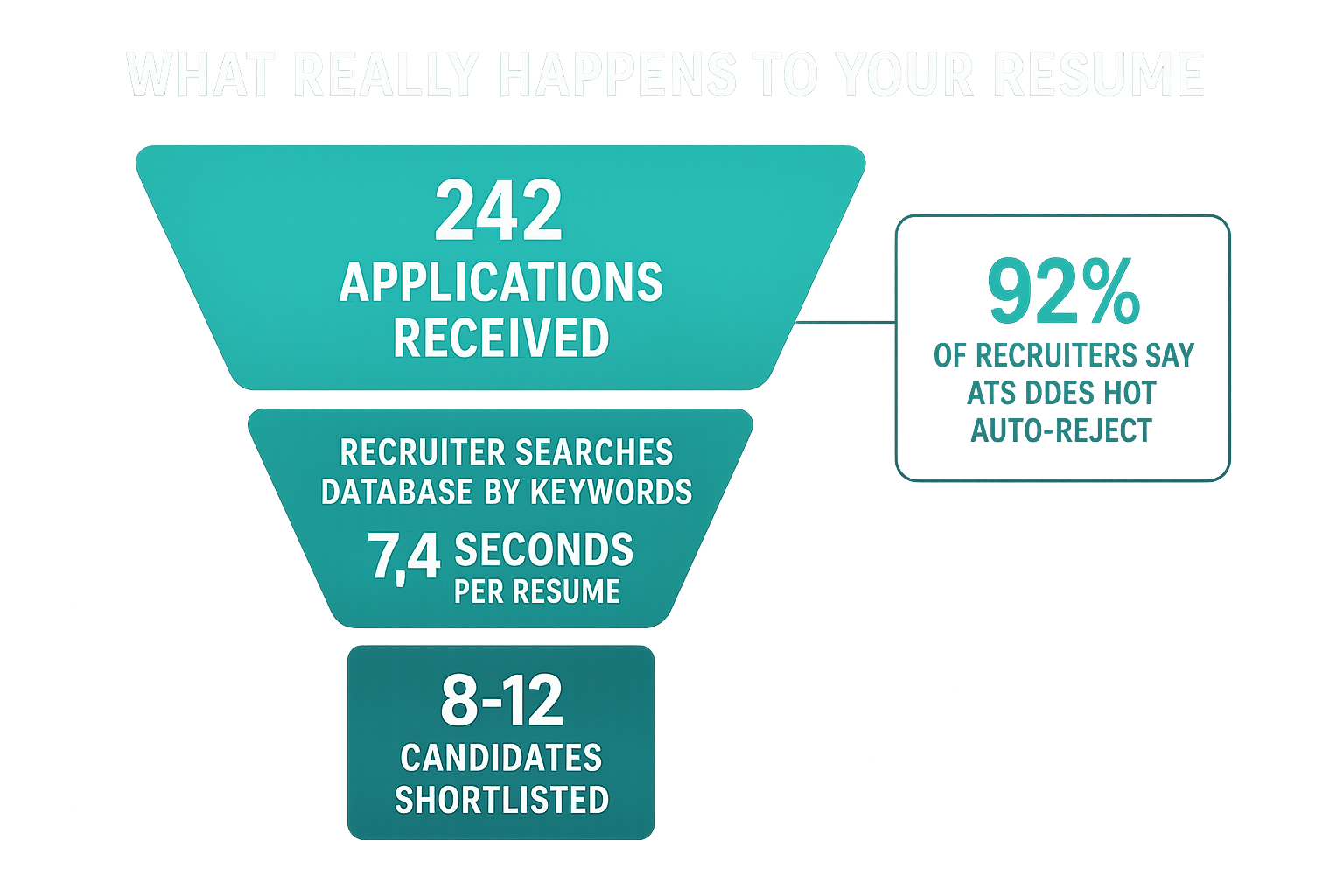
If ATS isn’t auto-rejecting your resume, what are recruiters actually doing with it? The 2025 Enhancv study surveyed 25 U.S. recruiters across healthcare, tech, construction, consumer goods, education, and retail — organizations ranging from 120 to 50,000+ employees, using 10+ different ATS platforms including Workday, iCIMS, Greenhouse, Bullhorn, and BambooHR.
The findings demolish the rejection myth.
92% of recruiters (23 out of 25) confirmed that their ATS does NOT auto-reject resumes for formatting, content, or design. Read that again. Ninety-two percent.
Only 8% — just 2 recruiters out of 25 — said they configure any kind of content-based auto-rejection, and only for extreme cases like “match below 75%” or “fewer than 7 of 10 required skills.”
Yes, 100% of recruiters use knockout questions. But these are compliance and eligibility checks — work authorization, required licenses, willingness to relocate. They’re not filtering your resume because you used a two-column layout or a sans-serif font.
Charkin Whitehead, Recruitment Relationship Manager at Allegis Global Solutions, said it directly: “The ATS systems that I’ve worked with don’t automatically disposition people — we have to go in and do it ourselves.”
And Crystal Hughes, Director of Talent at Accuserve Solutions, added: “We don’t want to miss out on a qualified applicant…”
Understanding how recruiters actually use ATS changes the entire optimization game. Rather than trying to “trick” a robot, you need to be findable when a human searches.
Recruiters typically search by:
This means the real optimization isn’t about invisible keywords or white-text hacks. It’s about using the same language the job posting uses and making your most relevant qualifications easy to find in a 7.4-second scan.
The ATS market is dominated by a handful of platforms — Greenhouse (19.3%), Lever (16.6%), Workday (15.9%), and iCIMS (15.3%) according to Jobscan’s 2025 data. None of these systems are designed to auto-reject. They’re all built as searchable databases with workflow management.
Now that we’ve killed the myth, let’s talk about what actually works. Because here’s the uncomfortable truth: most ATS advice on social media is either outdated, oversimplified, or designed to sell you something.
Does formatting matter? Yes — but not in the way most advice suggests. You don’t need to strip your resume of all personality and design. You need to ensure the ATS can parse your information correctly.
The basics that actually matter:
That’s it. You don’t need a special “ATS template.” You need a well-organized resume that’s easy for both software and humans to read.
Keyword matching matters — but not the way the myth suggests. You’re not trying to hit a magic score that unlocks a gate. You’re trying to show up when a recruiter searches for specific terms.
The approach that works:
What to avoid: white-text keyword stuffing (ManpowerGroup now detects hidden text in roughly 100,000 résumés per year — about 10% of those scanned), copying entire job descriptions into your resume, and using keyword-stuffing tools that sacrifice readability for match scores.
This is the simplest fix with the highest impact. ATS platforms parse your resume by identifying sections. When you get creative with section names, the parser might miscategorize your information — or miss it entirely.
Use these: Work Experience, Education, Skills, Certifications, Summary/Professional Summary
Avoid these: “Where I’ve Been,” “My Toolbox,” “The Good Stuff,” “Career Highlights Reel”
Creative headers might work on a personal portfolio site. On a resume being parsed by software, they create unnecessary risk for zero benefit.
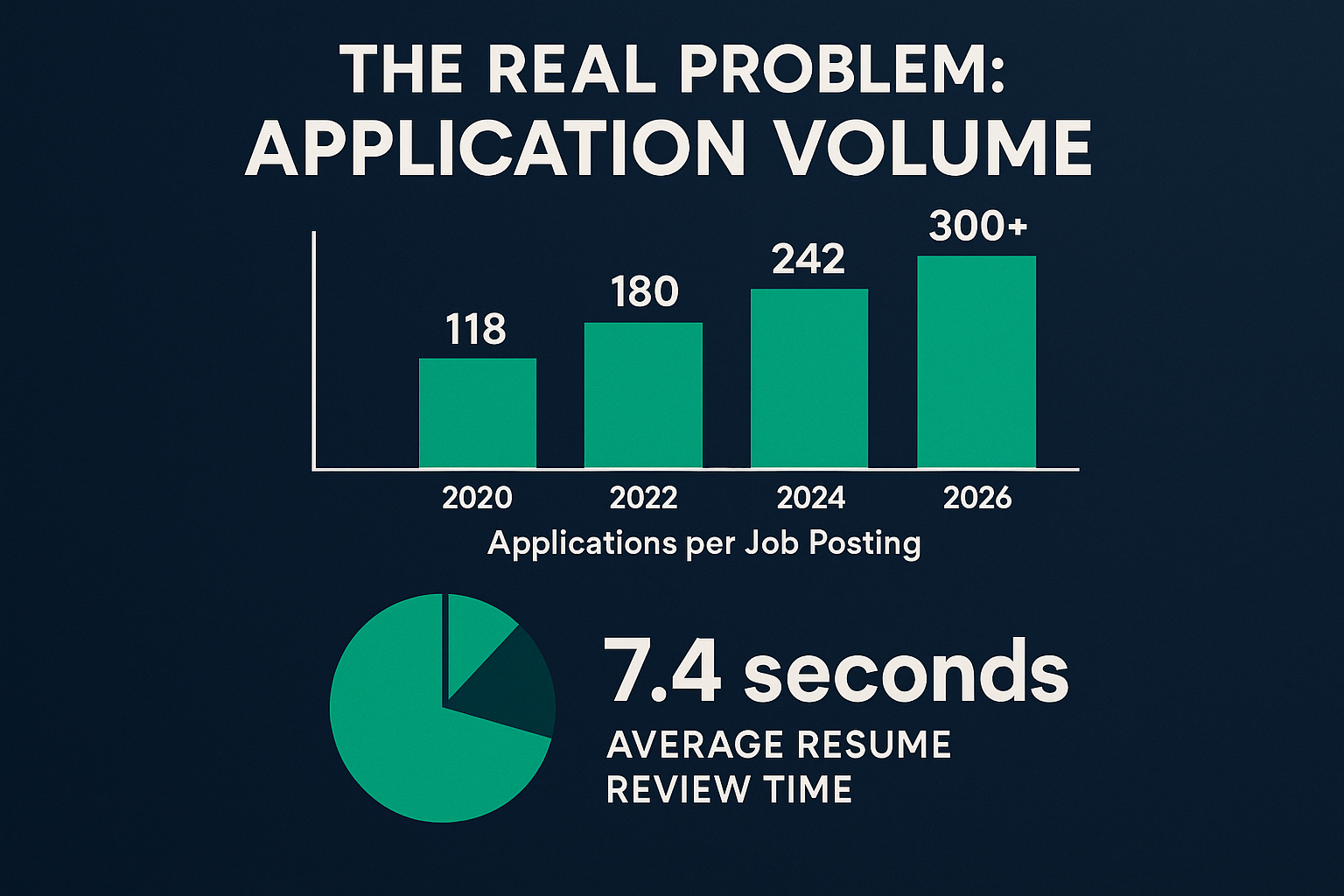
Here’s where we move beyond ATS altogether — because getting past the ATS was never the hard part. The hard part is what comes after: standing out among 242 applicants when a recruiter has 7.4 seconds to decide if you’re worth a closer look.
The most effective way to get hired hasn’t changed in decades, and it has nothing to do with ATS optimization. Referrals and warm introductions remain the highest-converting channel for job seekers.
When someone inside the company vouches for you, your resume doesn’t need to “beat” anything. It gets pulled up directly. The recruiter already has context. You’ve skipped the 242-applicant pile entirely.
This doesn’t mean cold applications are useless — they’re not. But if you’re spending 100% of your job search time optimizing resume keywords and 0% building relationships with people at target companies, your strategy is backwards.
Allocate your time accordingly: networking and outreach should be at least 40% of your job search effort. The remaining 60% should be split between tailored applications and skill development.
While the old “ATS rejects you” narrative is false, there IS a new reality in 2026: AI-powered hiring tools are being layered on top of traditional ATS platforms. These tools can analyze candidate fit, flag potential matches, and even conduct initial screening conversations.
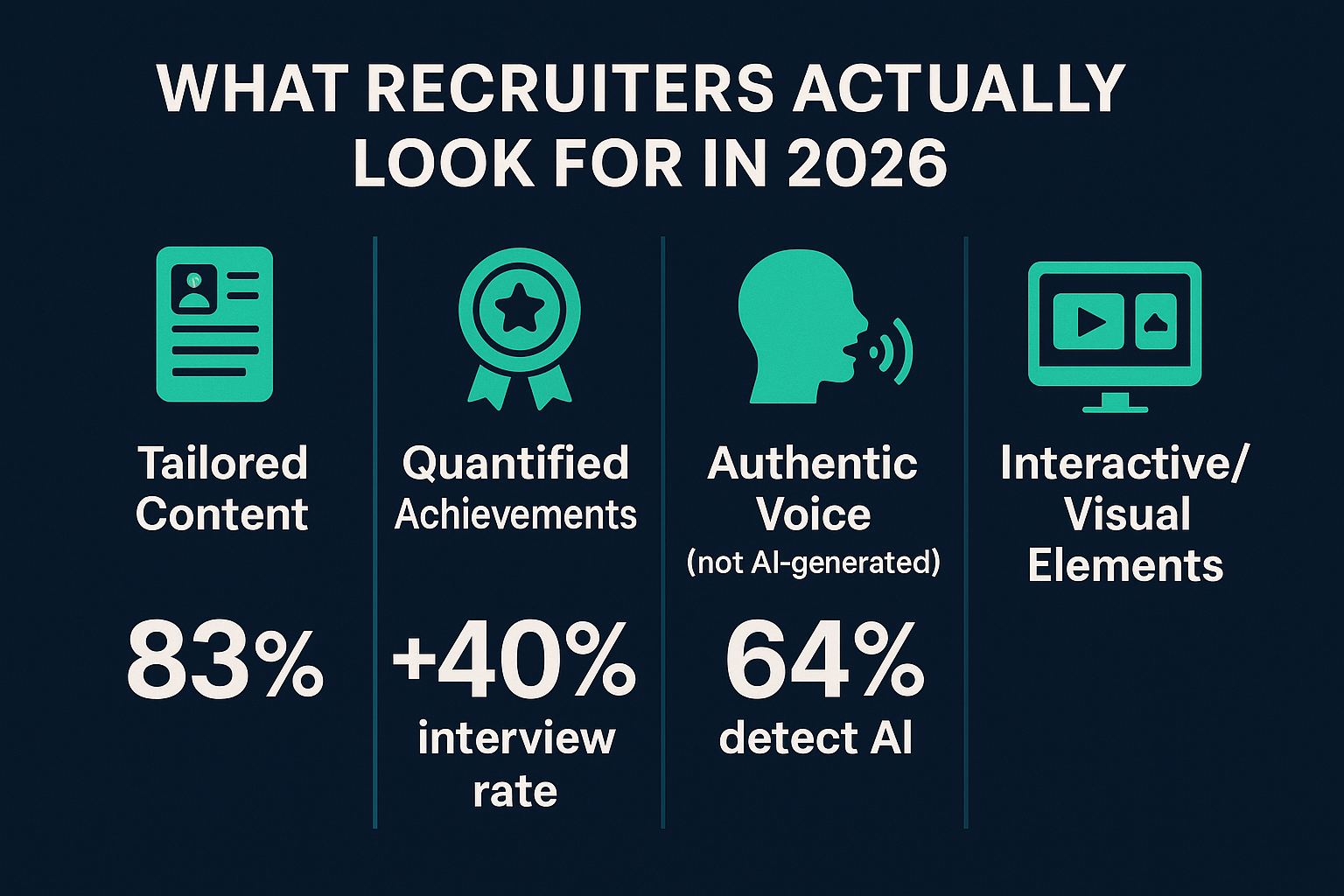
But here’s the irony that should concern every job seeker: 74% of hiring managers report they’ve detected AI-generated content in applications (The Interview Guys, 2025). And 62% of employers say they reject AI-generated resumes that lack personalization (Resume Now, 2025).
So job seekers are using AI to “beat the ATS” — and employers are using AI to detect AI-generated applications. The arms race is creating a new problem: a sea of identical-sounding, AI-polished resumes that all blur together.
78% of hiring managers say personalized details signal genuine interest and fit. In a world where everyone’s resume sounds like it was written by ChatGPT, the most powerful differentiator is being authentically, specifically, undeniably you.
The data on what actually moves the needle is clear:
Tailoring works. Job seekers who customize resumes for each application see a 50% higher success rate — 6.5% conversion vs. 4.3% for generic resumes, according to Huntr’s Q3 2025 data. Their Q2 2025 report showed even starker results: tailored resumes achieved 5.75% conversion vs. 2.68% for non-tailored — a 115% improvement.
Quantified achievements matter. Including measurable results on your resume is associated with a 40% higher interview rate. Yet only 8% of resumes include metrics in their job titles. That’s a massive gap — and an opportunity for you.
Aligning your resume title with the job title increases interview rates approximately 3.5× according to a 2024 analysis of over 1 million applications.
None of these strategies require “beating” an ATS. They require beating the other 241 humans who applied for the same role.
Let’s bring it all together with a practical framework. The goal isn’t to “beat ATS” — it’s to get found in the database AND impress the human who finds you.
Before submitting any application, run through this checklist:
This checklist works because it optimizes for both the database search (items 1-4) and the human review (items 5-7). Most ATS advice only addresses the first half.
Want to verify your resume is parseable? There are practical ways to check:
You can also see what’s wrong with your documents using diagnostic tools that analyze both ATS compatibility and human readability — because optimizing for one without the other is only half the equation.
And if you want to see what the experience feels like from the recruiter’s side, try the demo to understand how interactive presentations change the dynamic.
Here’s the frontier most job seekers haven’t discovered yet.
Research from the Journal of Business and Psychology (2022) found that visual resumes with design elements, branding, and storytelling achieve a 32% higher callback rate than standard templates. A ResumeGo study showed that including a LinkedIn profile link on your resume increases your interview chances by 71%. And a field experiment published as an IZA Discussion Paper found video resumes increased callback rates by 10 percentage points.
The pattern is clear: the more dimensions of you a recruiter can see, the better your outcomes.
This is where the smartest job seekers in 2026 are going beyond the traditional resume entirely. Instead of relying solely on a static PDF, they’re creating interactive experiences — multimedia presentations that showcase projects, embed video introductions, demonstrate skills with real work samples, and tell a richer career story than any one-page document could.
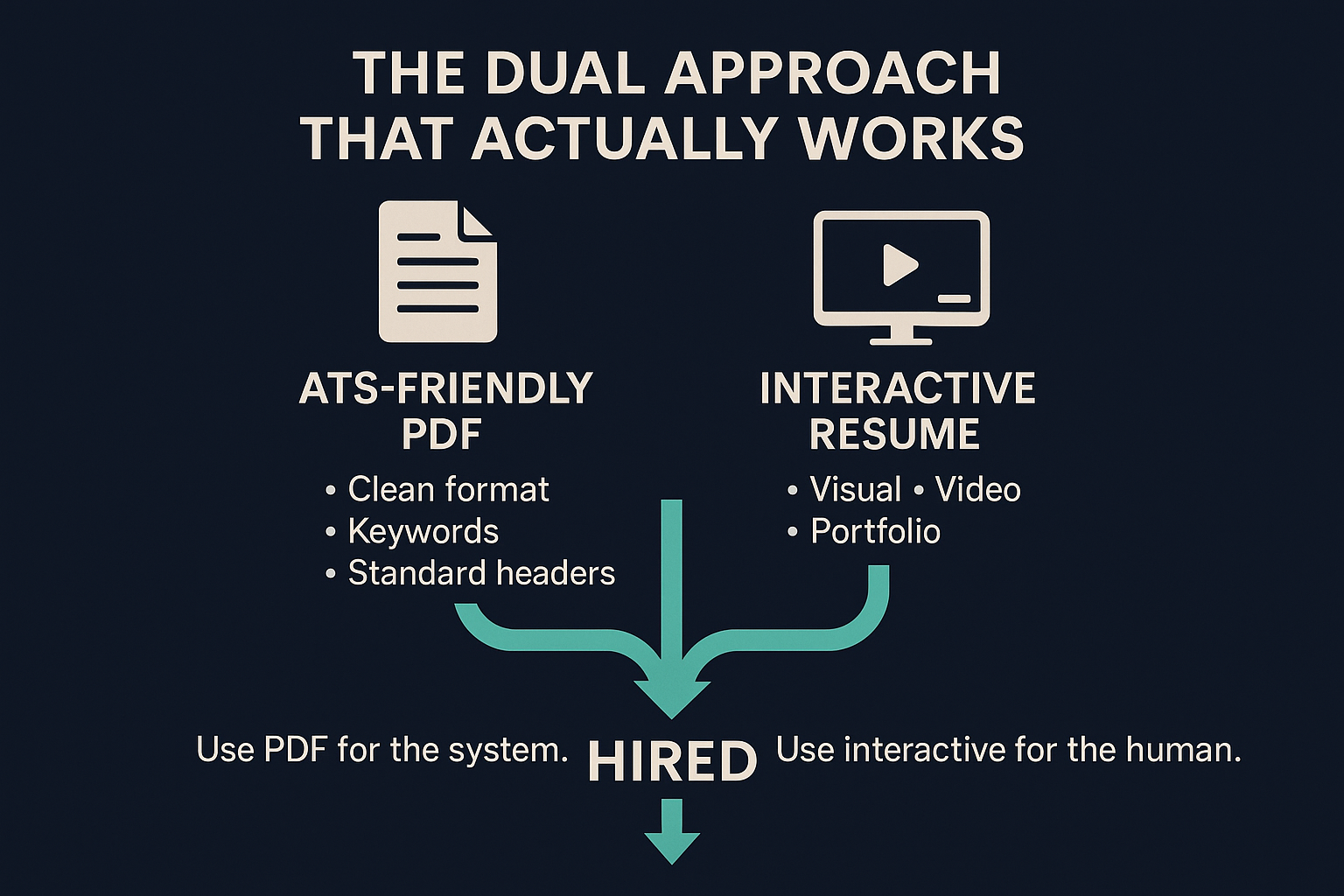
The strategy isn’t either/or. It’s both. Submit the ATS-friendly PDF through the application portal. Then, in your cover letter, networking outreach, or follow-up email, share a link to your interactive resume experience. The PDF gets you into the database. The interactive version gets you remembered.
Think of it this way: your ATS-formatted resume is the ticket that gets you through the door. Your interactive experience is what makes the recruiter pull up a chair and actually pay attention.
Platforms like Libertify let you transform your resume into an interactive experience in minutes — no design skills required. Upload your existing resume, and the AI creates a shareable, multimedia presentation that goes far beyond what a .docx can convey. For HR and People Ops teams, it also means a richer, faster way to evaluate candidates.
Let’s zoom out and look at why this myth is so damaging.
In 2026, the average job posting receives 242 applications. That’s a 0.4% success rate per applicant. Meanwhile, the U.S. had 6.5 million job openings in December 2025 (BLS JOLTS data) — down 29.4% from March 2022 peaks. Fewer openings, more applicants per opening.
The TheLadders eye-tracking study found recruiters spend just 7.4 seconds on initial resume screening. In those 7.4 seconds, they focus on: current title, current company, dates, then skills. That’s it.
So here’s the math that should reshape your entire job search strategy:
The “ATS rejection” narrative gives job seekers a comforting villain — an impersonal robot to blame. The truth is harder: a real human looked at your resume and moved on in under 8 seconds. That’s not a technology problem. That’s a differentiation problem.
And here’s the cruel irony: the ATS optimization industry profits from the myth. Resume scanning tools, keyword optimizers, and “ATS score” checkers all depend on you believing that a robot is standing between you and your dream job. Even Jobscan — which sells ATS optimization — admits ATS doesn’t reject resumes. They know. They sell the solution to a problem they acknowledge doesn’t work the way people think.
Stop optimizing for myths. Start optimizing for reality. Here’s your revised strategy:
The job seekers who win in 2026 won’t be the ones who cracked some ATS code. They’ll be the ones who understood that the real challenge was always human — and rose to meet it.
No. A 2025 Enhancv study found that 92% of recruiters confirm their ATS does NOT auto-reject resumes based on formatting, content, or design. ATS functions as a searchable database — it stores your resume and lets recruiters search by keywords and filters. The widely-cited “75% rejection” statistic originated from a 2012 sales pitch by a defunct company and has no supporting methodology.
Use a .docx or .pdf file with standard section headers (Work Experience, Education, Skills), a clean hierarchy of job titles and dates, and keywords placed in context rather than stuffed into lists. Avoid creative section names, text boxes in headers/footers, and image-based PDFs. The goal is making your resume parseable by software AND scannable by humans in 7.4 seconds.
AI can help you tailor your resume to specific job descriptions and identify keyword gaps. However, 74% of hiring managers now detect AI-generated content, and 62% reject AI resumes lacking personalization. Use AI as a drafting assistant, but always add your authentic voice, specific achievements, and genuine personality. The best approach combines AI efficiency with human authenticity.
Free ATS scanners like Jobscan can be useful as a sanity check to ensure your resume is parseable and includes relevant keywords. However, don’t obsess over match scores — they measure database searchability, not whether you’ll get hired. Your time is better spent tailoring your resume content (115% higher conversion rate) and quantifying achievements (40% higher interview rate) than chasing a perfect ATS score.
If you’re applying through an online portal (especially at mid-size or large companies), an ATS is almost certainly involved — 99% of Fortune 500 companies use one. Look for platform indicators in the URL (greenhouse.io, lever.co, workday.com, icims.com). But remember: using an ATS doesn’t mean your resume gets auto-rejected. It means it’s stored in a database that recruiters search through manually.
Sources: Enhancv 2025 Recruiter Study, Jobscan, TheLadders Eye-Tracking Study, Huntr Q2/Q3 2025 Job Search Trends, Resume Now AI & Applicant Report 2025, The Interview Guys State of Job Search 2025, BLS JOLTS Data Dec 2025, Journal of Business and Psychology 2022, IZA Discussion Paper No. 13656.