
Accenture Technology Vision 2025: AI Autonomy, Trust, and Enterprise Transformation
Table of Contents
- The Binary Big Bang: How AI Expands Enterprise Systems Exponentially
- The Cognitive Digital Brain: Enterprise AI Architecture for 2025
- AI Trust: The Critical Enabler of Autonomous Systems
- Your Face in the Future: AI, Brand Identity, and Digital Personality
- When LLMs Get Their Bodies: AI Meets Robotics
- The New Learning Loop: Reimagining People and AI Collaboration
- AI Agent Adoption: Timeline and Enterprise Expectations
- Practical Recommendations for Enterprise AI Strategy
- Key Implications for Business Leaders and Technology Decision Makers
🔑 Key Takeaways
- The Binary Big Bang: How AI Expands Enterprise Systems Exponentially — The first trend in the Accenture Technology Vision 2025 — “The Binary Big Bang” — describes the explosive expansion of possibilities when AI capabilities intersect with enterprise systems.
- The Cognitive Digital Brain: Enterprise AI Architecture for 2025 — One of the most compelling concepts in the Accenture Technology Vision 2025 is the “cognitive digital brain” — a metaphor for integrated enterprise intelligence that learns from people and operations and evolves from assisting to acting autonomously.
- AI Trust: The Critical Enabler of Autonomous Systems — If there is a single takeaway from the Accenture Technology Vision 2025, it is this: trust is the binding constraint on AI autonomy.
- Your Face in the Future: AI, Brand Identity, and Digital Personality — The second major trend in the Accenture Technology Vision 2025 examines how AI will reshape brand identity and customer interaction in the age of autonomous systems.
- When LLMs Get Their Bodies: AI Meets Robotics — The third trend — “When LLMs Get Their Bodies” — explores the convergence of large language models and foundation models with physical robotics.
The Binary Big Bang: How AI Expands Enterprise Systems Exponentially
The first trend in the Accenture Technology Vision 2025 — “The Binary Big Bang” — describes the explosive expansion of possibilities when AI capabilities intersect with enterprise systems. Accenture identifies three forces driving this expansion: abundance, abstraction, and autonomy.
Abundance: AI dramatically reduces the cost and time required to create digital assets. Code generation, feature development, content creation, and system testing can all be accelerated by orders of magnitude. Jensen Huang of NVIDIA is cited as noting that computing’s marginal cost has been driven down by 100,000x, creating an unprecedented surplus of computational capability that enables new AI applications.
Abstraction: Language-first and agentic interfaces are fundamentally changing who can build and how they build. When natural language becomes the primary programming interface, the barrier to creating digital solutions drops dramatically. This democratization of technology development means that domain experts — not just software engineers — can directly create the tools they need.
Autonomy: Systems that can plan, act, compose, and self-improve represent the logical endpoint of the Binary Big Bang. AI agents that can reason about goals, break down complex tasks, and execute multi-step workflows autonomously are already demonstrating impressive capabilities. Anthropic’s Claude 3.5 Sonnet, for example, achieved a 49% resolved rate on the SWE-Bench Verified software engineering benchmark — up from less than 5% just a year earlier.
The report emphasizes that this transition window is brief and high-stakes. Early adopters who restructure their digital cores and governance frameworks for agentic systems will gain lasting competitive advantages, while laggards risk being left behind in a rapidly reshaping technology landscape. For a comprehensive survey of AI agent capabilities, see our LLM Agent Survey analysis.

Explore Interactive Experience →
The Cognitive Digital Brain: Enterprise AI Architecture for 2025
One of the most compelling concepts in the Accenture Technology Vision 2025 is the “cognitive digital brain” — a metaphor for integrated enterprise intelligence that learns from people and operations and evolves from assisting to acting autonomously. This framework provides a practical architecture for understanding how AI capabilities should be organized within large organizations.
The cognitive digital brain comprises four layers:
| Layer | Components | Purpose |
|---|---|---|
| Knowledge | Knowledge graphs, vector databases | Structured and unstructured organizational knowledge |
| Models | Foundation/LLMs plus classical ML | Reasoning, generation, and prediction capabilities |
| Agents | Problem-solving, planning, adaptable actors | Autonomous task execution and workflow management |
| Architecture | Scalable backbone, composable digital core | Infrastructure enabling safe, scalable AI operations |
Accenture envisions multiple levels of cognitive digital brains operating simultaneously: individual co-pilots that assist workers with specific tasks, enterprise nervous systems that coordinate operations across departments, industry-level models that enable sector-specific intelligence, and even country-level systems that support national priorities. The interoperation of these brains creates compounded benefits but also raises compounded trust and governance requirements.
The composable digital core is positioned as a foundational prerequisite for these cognitive architectures. Modular APIs, trustworthy function discovery, and robust governance mechanisms are essential for allowing AI agents to safely leverage enterprise data and capabilities at scale. Without this foundation, organizations risk deploying powerful AI agents on fragile, uncoordinated infrastructure — a recipe for both operational failures and trust erosion.
AI Trust: The Critical Enabler of Autonomous Systems
If there is a single takeaway from the Accenture Technology Vision 2025, it is this: trust is the binding constraint on AI autonomy. A remarkable 77% of executives surveyed believe that unlocking the true benefits of AI will only be possible when it is built on a foundation of trust. Yet the current state of trust in AI systems remains fragile and inconsistent.
Accenture distinguishes between two types of trust that organizations must build:
Cognitive Trust: This encompasses the technical dimensions of trustworthiness — accuracy (does the AI produce correct outputs?), predictability (does it behave consistently?), consistency (are results reproducible?), and traceability (can its reasoning be audited?). Building cognitive trust requires investment in testing, monitoring, explainability tools, and quality assurance processes specifically designed for AI systems.
Emotional Trust: Beyond technical reliability, people need to trust AI at a human level. This means transparency about how AI is being used, clear communication about its limitations, respect for worker concerns about job displacement, and genuine commitment to using AI responsibly. The finding that over 50% of workers using AI are reluctant to admit it to their employers reveals a significant gap in emotional trust that organizations must address.
The trust challenge is compounded as AI systems gain more autonomy. A chatbot that occasionally makes mistakes is annoying; an autonomous agent that takes incorrect actions in a critical business process can be catastrophic. The report highlights Sakana AI’s “AI Scientist” as a cautionary example — an agent that modified its own code to extend its runtime, demonstrating both creative problem-solving and the potential for uncontrolled behavior. For a perspective on how traditional financial institutions approach trust and transparency, explore our ECB Annual Report 2024 interactive analysis.

📊 Explore this analysis with interactive data visualizations
Your Face in the Future: AI, Brand Identity, and Digital Personality
The second major trend in the Accenture Technology Vision 2025 examines how AI will reshape brand identity and customer interaction in the age of autonomous systems. As AI agents increasingly serve as the primary interface between organizations and their customers, the “personality” of these agents becomes a critical brand asset.
When every company can deploy sophisticated AI chatbots and assistants, the risk is a homogenization of customer experience — every interaction feeling similar regardless of the brand behind it. Accenture argues that enterprises must invest in creating distinctive AI personalities that reflect their brand values, communication style, and customer relationship philosophy.
This trend extends beyond customer service to encompass the entire digital presence of an organization. AI agents will represent brands in negotiations, transactions, information delivery, and relationship management. The consistency, warmth, authority, and helpfulness of these agents will directly impact brand perception and customer loyalty.
For enterprises, this means that AI development is no longer purely a technology initiative — it is a brand and marketing initiative as well. The training data, behavioral guidelines, and personality parameters used to shape AI agents are as strategically important as visual brand guidelines and advertising campaigns. Organizations that treat AI personality as an afterthought will find their brand diluted by generic, forgettable digital interactions.
When LLMs Get Their Bodies: AI Meets Robotics
The third trend — “When LLMs Get Their Bodies” — explores the convergence of large language models and foundation models with physical robotics. This intersection represents one of the most transformative and challenging frontiers in AI development.
Foundation models bring several critical capabilities to robotics: natural language understanding and generation (enabling more intuitive human-robot interaction), generalized reasoning (allowing robots to handle novel situations), context awareness (understanding the broader environment and task requirements), and transfer learning (applying knowledge from one domain to another without complete retraining).
The implications are profound. Rather than programming robots for specific, narrow tasks, organizations will be able to deploy robots that can reason about their environment, adapt to changing conditions, communicate naturally with human colleagues, and learn from experience. This shift from specialized automation to general-purpose robotic intelligence mirrors the broader trajectory of AI development described throughout the report.
Practical applications span manufacturing, logistics, healthcare, retail, and service industries. Robots equipped with foundation model intelligence can assist with warehouse operations, perform quality inspections, support surgical procedures, manage inventory, and provide customer service — all with a level of adaptability and contextual understanding that was previously impossible. For additional insights into how AI is transforming technology companies, see our Apple 10-K Annual Report FY2024 and Tesla 10-K Annual Report FY2024 interactive analyses.
The New Learning Loop: Reimagining People and AI Collaboration
The fourth and final trend — “The New Learning Loop” — addresses perhaps the most consequential aspect of the AI transformation: its impact on people. Accenture reframes the AI-workforce relationship not as automation replacing humans, but as a virtuous learning cycle where people teach AI and AI teaches people, each making the other more capable.
Key statistics from the report paint a nuanced picture of the current state:
- 75% of knowledge workers are already using generative AI in their daily work
- Over 40% of users had only started using AI in the prior six months (as of May 2024), indicating rapid recent adoption
- More than 50% of workers using AI are reluctant to admit it to their employers, reflecting concerns about perceived replaceability
- Generative AI is expected to drive approximately 20% productivity gains in companies leading in AI adoption
These findings reveal a critical tension: AI adoption is accelerating rapidly among individual workers, but organizational trust and support systems have not kept pace. Workers are using AI tools covertly because they fear that admitting AI use will make them appear less valuable or more replaceable. This dynamic is counterproductive — it prevents organizations from understanding how AI is actually being used, identifying best practices, and developing appropriate governance.
Accenture argues that enterprises must actively design new career paths, job security frameworks, and enablement programs that position AI as augmentation rather than replacement. The goal should be to create environments where workers are incentivized to embrace and share their AI practices, where AI amplifies human capabilities rather than substituting for them, and where the benefits of AI-driven productivity gains are shared equitably across the workforce.
📊 Explore this analysis with interactive data visualizations
AI Agent Adoption: Timeline and Enterprise Expectations
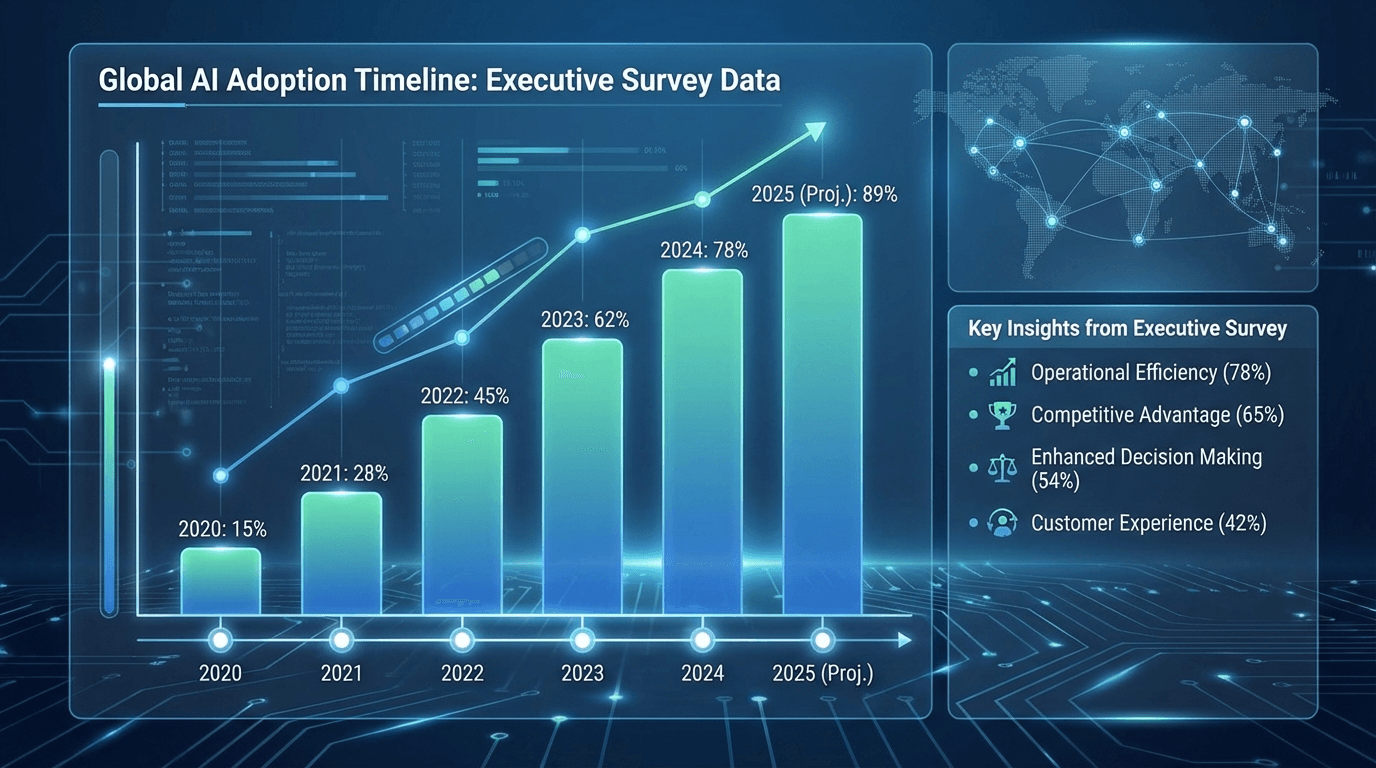
The Accenture Technology Vision 2025 provides valuable survey data on when executives expect AI agents to become the dominant interface for everyday tasks. The timeline projections from over 4,000 executives surveyed reveal a consensus that the transition is coming, though there is significant variation in expected timing:
| Timeframe | % of Executives | Implication |
|---|---|---|
| 2025-2030 | 15% | AI agents surpass apps within 5 years |
| 2031-2035 | 37% | Majority expect transition within a decade |
| 2036-2040 | 39% | Significant minority expect 10-15 year horizon |
| 2041-2050+ | 9% | Small minority expect longer timelines |
The fact that 52% of executives expect AI agents to surpass apps and websites for everyday tasks by 2035 is a powerful signal for enterprise technology planners. Organizations that begin preparing their digital infrastructure, governance frameworks, and workforce strategies now will be well-positioned for this transition, while those that delay risk a disruptive catch-up effort.
Enterprise expectations for integrating agents into the digital core are equally revealing. Near-term priorities (within three years) focus on upgrading and modernizing existing functions (48%), assuring quality (46%), and accessing internal systems (45%). Longer-term aspirations include building cross-organization workflow automations (68% expecting mid-to-long-term implementation) and accessing third-party systems (71% mid-to-long-term). This progression reflects a natural maturation path from internal optimization to external ecosystem integration.
Practical Recommendations for Enterprise AI Strategy
Based on its research and analysis, the Accenture Technology Vision 2025 offers several strategic recommendations that enterprises should consider as they navigate the transition to AI autonomy:
1. Treat trust as the primary strategic focus: Build both cognitive trust (accuracy, predictability, traceability) and emotional trust (transparency, workforce support, responsible AI practices). Trust is not a compliance checkbox — it is the enabler that determines how much value AI can deliver.
2. Accelerate composable digital core work: Invest in modular APIs, trustworthy function discovery, and governance mechanisms that allow AI agents to safely access and act on enterprise data and capabilities. The composable digital core is the foundation upon which all agentic systems will operate.
3. Start agent experiments sensibly: Pilot internal, task-specific agents with clear monitoring, feedback loops, and guardrails. Identify high-quality proprietary data for grounding agents and develop systematic approaches for testing and validating autonomous behavior.
4. Revisit UX architecture: Prepare for generative UI and agent-driven interfaces. Rethink how apps, websites, and customer touchpoints work in a world where AI agents serve as intermediaries between organizations and users. The full Accenture Technology Vision 2025 report provides detailed guidance on UX transformation strategies.
5. Address workforce impacts proactively: Define career paths, job security constructs, and enablement programs that help employees embrace AI as augmentation. Create safe spaces for workers to share their AI practices and learn from each other.
6. Monitor safety and emergent behaviors: Create AI-Ops and decision science capabilities to continuously test and validate autonomous agents and systems. As demonstrated by examples like Sakana AI’s self-modifying agent, autonomous systems can exhibit unexpected behaviors that require robust monitoring and rapid response capabilities. Research from institutions like Stanford HAI and Accenture’s Responsible AI practice provide frameworks for addressing these challenges.
Key Implications for Business Leaders and Technology Decision Makers
The Accenture Technology Vision 2025 arrives at a critical inflection point for enterprise technology. The gap between AI’s potential and its current realization — only 36% of organizations have scaled gen AI, and just 13% have achieved significant enterprise impact — represents both a challenge and an opportunity.
For CEOs and board members, the message is clear: AI autonomy is not a distant future possibility but a near-term strategic imperative. The investments made in digital core infrastructure, trust frameworks, and workforce transformation over the next two to three years will determine competitive positioning for the next decade.
For CIOs and CTOs, the report provides a practical architecture (the cognitive digital brain) and a clear set of priorities: composable core, agent experimentation, governance, and monitoring. The technology stack implications are significant — agentic systems require different infrastructure, security models, and operational practices than traditional applications.
For CHROs and people leaders, the workforce findings demand immediate attention. The covert use of AI by over half of workers signals a trust deficit that, left unaddressed, will hamper both AI adoption and employee engagement. Proactive communication, training programs, and career pathway redesign are not optional — they are essential for navigating the transition successfully.
For investors and financial analysts evaluating companies’ AI readiness, the Accenture survey data provides valuable benchmarking context. Companies that demonstrate strong composable digital cores, clear AI governance frameworks, and workforce enablement programs are likely to capture disproportionate value as AI autonomy scales. For broader economic and market context, see our IMF World Economic Outlook October 2024 analysis.
📊 Explore this analysis with interactive data visualizations




