State of AI 2025: What McKinsey’s Report Reveals About the Enterprise AI Gap
Table of Contents
- 1. The State of AI 2025: An Adoption Surge That Masks Deeper Problems
- 2. The Scaling Gap: Why 67% of Companies Are Stuck in Pilot Mode
- 3. The 5.5% — What Separates AI High Performers from Everyone Else
- 4. Workflow Redesign: The #1 Driver of AI-Driven Business Impact
- 5. The Rise of Agentic AI: From Chatbots to Autonomous Workflows
- 6. Leadership & Governance: The C-Suite Must Lead (But Most Don’t)
- 7. Risk, Talent & the Human Factor in AI Adoption
- 8. AI ROI Statistics 2025: The $4.4 Trillion Question
- 9. What This Means for Your Organization — And How to Act
📌 Key Takeaways
- 78% of organizations now use AI in at least one business function — up from 72% in early 2024
- 71% regularly use generative AI across functions like marketing, product development, and IT
- Only 5.5% are “AI high performers” — seeing >5% EBIT impact from AI initiatives
- Only 21% have redesigned workflows — the single most correlated factor with AI-driven value
- 62% are experimenting with AI agents, but just 23% are scaling them
- 47% have experienced negative consequences from gen AI, highlighting the governance imperative
- $2.6–$4.4 trillion in annual economic value potential across 63 gen AI use cases
- High performers are 3× more likely to have strong senior leadership engagement with AI
1. The State of AI 2025: An Adoption Surge That Masks Deeper Problems
The headline number from the McKinsey AI report 2025 is impossible to ignore: 78% of organizations now use AI in at least one business function, up from 72% in early 2024. Generative AI use has surged even faster — 71% of organizations regularly deploy gen AI across marketing, product development, service operations, and IT.
But these numbers tell a misleading story if you stop there. As McKinsey’s researchers Alex Singla, Alexander Sukharevsky, and Lareina Yee make clear: adoption alone is not the goal — value creation is. And on that metric, the picture is dramatically different.
Two-thirds of organizations are using AI in multiple functions. About half use it in three or more. This is ubiquity. But ubiquity without depth, discipline, or design is what McKinsey calls the “AI theater” problem — organizations going through the motions of AI adoption without rewiring the operating model to capture real value.
What the Numbers Reveal vs. What They Hide
The adoption curve is flattening at the top, which means the competitive advantage has shifted. It’s no longer about whether you use AI — it’s about how deeply you’ve integrated it into workflows, decision-making, and value chains. This is the central argument of the state of AI 2025 report, and it’s the one most summary articles fail to emphasize.
2. The Scaling Gap: Why 67% of Companies Are Stuck in Pilot Mode
Perhaps the most consequential finding in the entire McKinsey AI report 2025 is the scaling gap. While adoption is widespread, only about one-third of organizations report scaling AI across the enterprise. The remaining two-thirds are trapped in what industry observers call “pilot purgatory” — running experiments that never graduate to production at scale.

The blockers are consistent across industries and company sizes:
- Data quality and architecture: Scaling requires clean, integrated, well-governed data — not the siloed spreadsheets and legacy databases most organizations operate on
- Workflow rigidity: Bolting AI onto unreformed processes produces marginal gains at best
- Operating model inertia: Functional silos, unclear ownership, and misaligned incentives prevent cross-organizational AI deployment
- Measurement gaps: Without clear KPIs tied to business outcomes, pilot programs can’t make the case for enterprise-wide investment
Larger companies (revenue >$5B) are more likely to be scaling — nearly half are in the “scaling” phase — but even they cite workflow and operating-model challenges as primary blockers. Smaller firms (<$100M revenue) face even steeper odds, with only 29% reporting any scaling progress.
This is where the generative AI business impact story becomes nuanced. The technology works. The challenge is organizational. As the report puts it: AI is 20% algorithms and 80% organizational rewiring.
3. The 5.5% — What Separates AI High Performers from Everyone Else
McKinsey’s survey identified a striking outlier cohort. Out of nearly 2,000 respondents, only 109 — roughly 5.5% — reported that more than 5% of their organization’s EBIT is attributable to AI. These are the “AI high performers,” and their practices diverge sharply from the mainstream.
This finding is remarkably consistent with MIT’s independent research, which found that only 5% of AI pilot programs generate measurable P&L impact. The alignment across two major studies makes this one of the most robust AI ROI statistics 2025 has produced.
The High Performer Playbook
What do these 5.5% do differently? McKinsey identifies six consistent patterns:
- They target transformation, not just efficiency. High performers are 3.6× more likely to say they intend to use AI for transformative change over the next three years. While 80% of all respondents cite efficiency, high performers add revenue growth and innovation as explicit AI objectives.
- They invest heavily. More than one-third of high performers allocate >20% of their digital budgets to AI — making them 5× more likely to make a significant financial bet than average organizations.
- Senior leadership is deeply engaged. High performers are 3× more likely to report that senior leaders demonstrate ownership of and commitment to AI initiatives — not just approving budgets, but actively role-modeling AI use.
- They redesign workflows end-to-end. The single strongest correlation with EBIT impact is fundamental workflow redesign (more on this in the next section).
- They scale across functions. High performers deploy AI in more business functions and are 3× more likely to be scaling AI agents across the organization.
- They run a full-stack management playbook across six dimensions: strategy, talent, operating model, technology, data, and adoption/scaling — based on McKinsey’s analysis of more than 200 at-scale AI transformations.
The implications are clear: the AI adoption enterprise gap isn’t a technology problem — it’s a leadership and operating model problem. And closing it requires a fundamentally different approach to how organizations engage with AI.
Want to see AI insights in action? Transform any report into an interactive experience.
4. Workflow Redesign: The #1 Driver of AI-Driven Business Impact
If there’s one finding that deserves to be printed on every CTO’s wall, it’s this: of all organizational changes linked to gen AI success, fundamental workflow redesign ranks highest in correlation with EBIT impact.
Yet only 21% of organizations using gen AI have redesigned at least some workflows. The vast majority — nearly 80% — are layering AI on top of existing processes without rethinking how work actually flows.
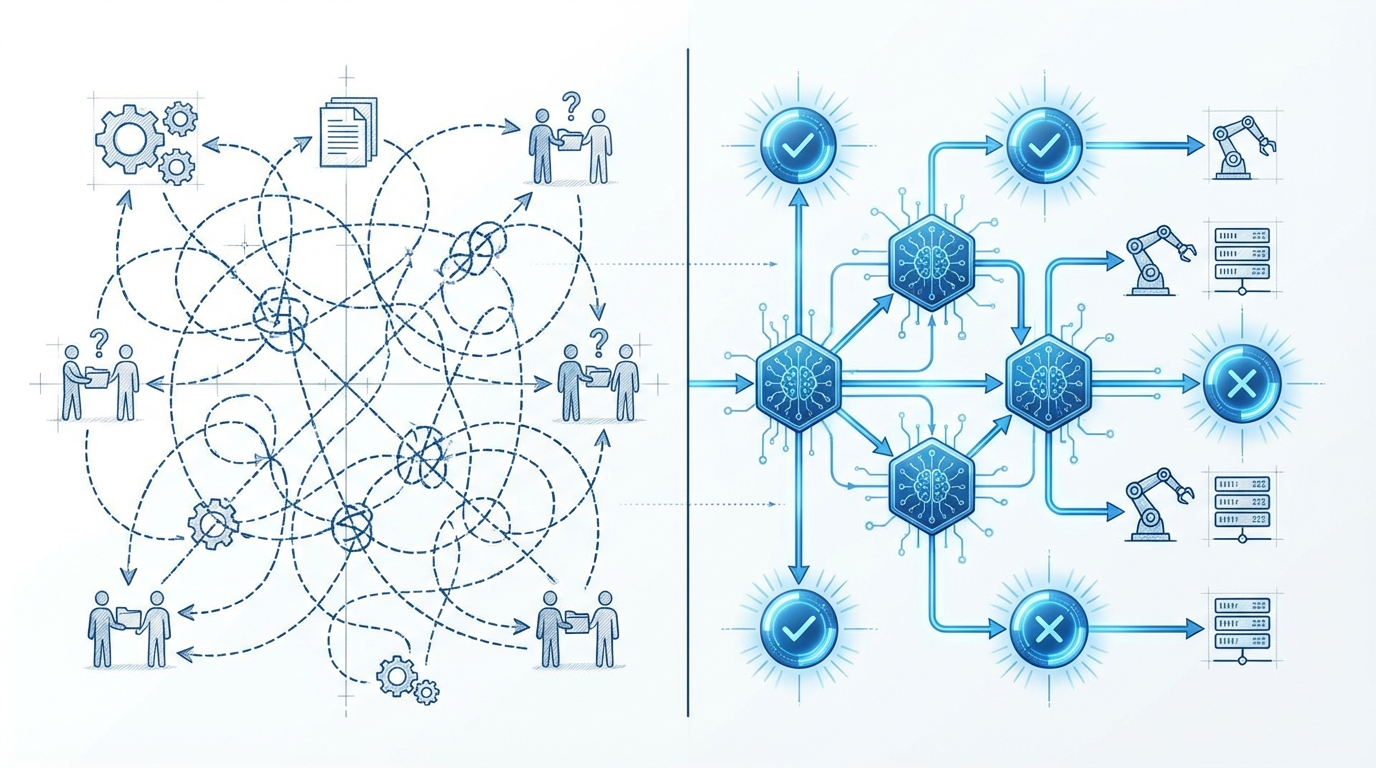
This is the fundamental disconnect that the state of AI 2025 report exposes: organizations are deploying powerful technology within legacy operating frameworks. It’s like installing a jet engine on a horse-drawn cart. The engine works fine — the vehicle just isn’t designed for it.
What Workflow Redesign Actually Looks Like
McKinsey’s high performers don’t just “add AI” to a process. They:
- Rebuild sales playbooks so AI handles research, personalization, and follow-up — with humans focused on relationship-building and strategic decisions
- Redesign customer support runbooks so AI agents handle L1 resolution end-to-end, escalating only genuine edge cases
- Re-platform knowledge bases and content repositories so AI can retrieve, synthesize, and act on institutional knowledge
- Restructure the software development lifecycle with AI-native code generation, testing, and deployment pipelines
This is the same insight that drives the shift from static PDFs to interactive documents. The technology to make content engaging, adaptive, and intelligent exists — but you have to redesign the delivery model, not just paste AI features onto a PDF viewer.
5. The Rise of Agentic AI: From Chatbots to Autonomous Workflows
One of the most forward-looking dimensions of the McKinsey AI report 2025 is its analysis of AI agents — systems that can plan, use tools, and execute multi-step workflows autonomously.
The data shows a clear adoption trajectory:
- 62% of organizations are experimenting with AI agents
- 23% are actively scaling AI agents in at least one function
- But in any given function, only up to 10% report truly scaled agent deployments
- In product development specifically, 73% are not using AI agents at all
The industries leading agentic adoption are tech, media, telecom, and healthcare. Within advanced manufacturing (aerospace, automotive, semiconductors), the top use cases for scaled AI agents are:
- Software engineering (10%)
- IT operations (9%)
- Product development (6%)
- Knowledge management (5%)
- Sales & marketing (5%)

The Agentic Divide
High performers are nearly 3× more likely to have scaled AI agents across the enterprise. This creates what analyst Brian Solis calls “Agentic Darwinism” — a widening gap between organizations treating AI as tools vs. those treating it as a new operating system.
The critical insight: you can’t redesign workflows (the #1 value lever) if humans must orchestrate every step. AI agents enable true end-to-end automation — but deploying them requires policy frameworks, retrieval systems, audit trails, and governance infrastructure that most organizations haven’t built yet.
This is precisely why tools like Libertify’s AI-driven document transformation platform matter: they represent the agentic approach to content — taking a static document and autonomously transforming it into an interactive experience with video, AI chatbot, and engagement analytics.
6. Leadership & Governance: The C-Suite Must Lead (But Most Don’t)
McKinsey’s data makes a compelling case that AI governance isn’t a compliance checkbox — it’s a direct driver of bottom-line results.
The findings on leadership engagement are stark:
- Only 28% of companies report that their CEO directly oversees AI governance
- Only 17% have board-level involvement in AI strategy
- Yet CEO oversight is strongly correlated with higher EBIT impact from AI
- High performers are 3× more likely to report that senior leaders actively champion, sponsor, and role-model AI use
The pattern is consistent: organizations where AI is a “tech team project” underperform those where it’s a CEO-level strategic priority. This isn’t about executives learning to code — it’s about leaders setting vision, removing blockers, redesigning incentives, and making AI adoption a cultural expectation rather than an optional experiment.
The Governance Gap
McKinsey outlines 12 best practices for AI scaling and adoption — from tracking KPIs to establishing clear roadmaps. But fewer than one-third of organizations have implemented most of them. Larger firms lead in creating dedicated gen AI adoption teams, rolling out employee training, and building trust frameworks, but even they have significant gaps.
Risk management is becoming more sophisticated, with growing investment in mitigating inaccuracy, cybersecurity threats, IP infringement, and privacy concerns since 2024. But the journey is far from complete — particularly around explainability and fairness, where most organizations remain immature.
Ready to make your documents more engaging? See how Libertify transforms static content.
7. Risk, Talent & the Human Factor in AI Adoption
The state of AI 2025 report surfaces a finding that should make every CHRO pay attention: 47% of organizations report having already experienced at least one negative consequence from generative AI.

The most commonly reported risks include:
- Inaccuracy and hallucinations — outputs that sound authoritative but are factually wrong
- Data leakage and privacy violations — sensitive information exposed through AI interactions
- IP and copyright concerns — uncertainty about ownership of AI-generated content
- Cybersecurity vulnerabilities — new attack surfaces created by AI integrations
- Change fatigue — employees overwhelmed by the pace of AI tool adoption
The Talent Equation
While hiring AI specialists (data scientists, ML engineers) remains challenging, the difficulty has decreased compared to previous years — a sign of growing talent supply. New roles are emerging, including AI compliance specialists and AI ethics officers.
Perhaps most notably, McKinsey found that employees often use AI more than their leaders realize — underscoring the need for enablement and policy rather than blanket bans. The most effective organizations are channeling this grassroots adoption through formal training, governance guardrails, and clear use-case guidelines rather than trying to suppress it.
Reskilling is accelerating: many companies have already retrained up to 10% of their workforce due to AI, with expectations for more in the next three years. Critically, most organizations are redeploying time saved through AI into new tasks rather than cutting headcount — suggesting that AI’s workforce impact is more about transformation than elimination.
8. AI ROI Statistics 2025: The $4.4 Trillion Question
McKinsey’s baseline economic sizing for generative AI remains staggering: $2.6–$4.4 trillion in annual value potential across 63 identified use cases. The largest value pools are concentrated in four areas:
- Customer operations — assisted resolution, knowledge surfacing, next-best-action
- Marketing & sales — personalized messaging, proposal assembly, pipeline optimization
- Software engineering — code generation, PR drafting, test automation, incident analysis
- Research & development — accelerated design cycles, literature synthesis, hypothesis generation
But the reality on the ground is sobering. Only 39% of organizations can link any EBIT impact to AI, and for most of those, the impact is below 5%. Over 80% still don’t see a clear enterprise-wide effect on their bottom line.
The organizations seeing the greatest returns are those that set growth and innovation objectives alongside cost reduction. Efficiency-only AI strategies produce incremental gains. Growth-oriented strategies — targeting customer satisfaction, competitive differentiation, and revenue expansion — are correlated with significantly larger impact on profitability, market share, and customer experience.
Where are cost reductions concentrated? Software engineering, manufacturing, and IT. Where are revenue gains concentrated? Marketing & sales, strategy & corporate finance, and product development. Understanding this map is essential for prioritizing AI investment.
9. What This Means for Your Organization — And How to Act
The McKinsey State of AI 2025 report tells a clear story: AI won’t create enterprise value by itself. Value arrives when leaders set growth targets, rewire workflows, adopt agent-ready infrastructure, and measure outcomes rigorously. If your pilots aren’t moving EBIT, the problem is almost certainly operating model and measurement — not the model itself.
Five Actions to Take Now
- Set outcome-based AI objectives. Move beyond “deploy AI” to “improve customer retention by X%” or “reduce time-to-market by Y days.” Align every AI initiative with a business KPI.
- Pick one workflow and redesign it end-to-end. Don’t sprinkle AI across 20 processes. Choose your highest-value workflow — e.g., L1→L2 customer support escalation, or SDR→AE sales handoff — and rebuild it with AI at the core.
- Build your agent-ready stack. Invest in retrieval-augmented generation (RAG), tool-calling infrastructure, policy guardrails, and audit trails. Connect AI agents to your CRM, knowledge bases, ticketing systems, and CI pipelines.
- Get leadership in the arena. If your CEO isn’t personally championing AI strategy and governance, you’re statistically less likely to see EBIT impact. Make AI a board-level topic, not a tech committee footnote.
- Measure what matters. Track adoption (active users, tasks automated), quality (hallucination rate, guardrail effectiveness), and business results (EBIT lift, revenue per employee). Build a financial model for every use case.
Start With Your Most Important Documents
Here’s a practical first step that most organizations overlook: transform your most critical documents into interactive experiences. Every enterprise has a library of reports, onboarding materials, compliance guides, and client-facing documents that are dense, unread, and underperforming.
This is exactly the problem Libertify solves. Our platform transforms complex PDFs and documents into interactive experiences — with AI-generated video walkthroughs, conversational chatbots that answer questions about the content, and analytics that show you exactly how your audience engages. It’s the kind of workflow redesign McKinsey’s data says drives real value — applied to the documents your business depends on.
If you want to see what this looks like in practice, scroll back up and explore the interactive Libertify experience of this very report. That’s the difference between a document that gets downloaded and a document that gets understood.
Sources & Further Reading
- McKinsey — The State of AI (QuantumBlack)
- McKinsey — The Economic Potential of Generative AI
- Libertify AI Insights Blog
Frequently Asked Questions
What is the McKinsey State of AI 2025 report about?
The McKinsey State of AI 2025 report, published by QuantumBlack, surveys nearly 1,500 organizations worldwide on AI adoption. It reveals that while 78% of organizations use AI, only 5.5% are ‘AI high performers’ seeing more than 5% EBIT impact — highlighting a massive gap between adoption and value creation.
What percentage of companies are successfully scaling AI in 2025?
Only about one-third of organizations report scaling AI across the enterprise. The remaining two-thirds are stuck in ‘pilot purgatory,’ running AI experiments that never graduate to production. The key blockers are data quality, workflow rigidity, operating model inertia, and measurement gaps.
What is agentic AI and why does it matter in 2025?
Agentic AI refers to AI systems that can autonomously execute multi-step tasks, use tools, and make decisions. McKinsey’s report shows 62% of organizations are experimenting with AI agents but only 23% are scaling them. Agentic AI represents the next frontier of enterprise AI, moving beyond chatbots to autonomous workflow execution.
How much economic value can generative AI create?
McKinsey estimates generative AI could create $2.6 to $4.4 trillion in annual economic value across 63 identified use cases. However, capturing this value requires workflow redesign, strong leadership engagement, and robust governance — factors that separate the 5.5% of high performers from the rest.
What do AI high performers do differently according to McKinsey?
AI high performers are 3× more likely to have strong senior leadership engagement, have redesigned workflows end-to-end (only 21% of all companies do this), set outcome-based objectives tied to business KPIs, invest in agent-ready infrastructure, and rigorously measure adoption, quality, and business results.