Attention Is All You Need: Complete Guide to the Transformer Paper That Revolutionized AI
📌 Key Takeaways
- The Transformer eliminates recurrence entirely — processing all tokens in parallel rather than sequentially, cutting training time from weeks to hours.
- Self-attention is the core innovation — every position in a sequence can directly attend to every other position in constant time O(1), versus O(n) for RNNs.
- Multi-head attention allows the model to jointly attend to information from 8 different representation subspaces simultaneously.
- Results were decisive — 28.4 BLEU on English-to-German translation, beating all prior models including ensembles, trained in just 3.5 days on 8 GPUs.
- Every major AI system today — GPT-4, Claude, Gemini, BERT, LLaMA — is built on the Transformer architecture introduced in this paper.
Why “Attention Is All You Need” Changed Everything
Published at NeurIPS 2017 by eight researchers at Google Brain and Google Research, Attention Is All You Need is arguably the most influential machine learning paper of the decade. The transformer architecture it introduced didn’t just improve machine translation — it rewrote the rules of artificial intelligence.
Before this paper, the dominant approach to sequence processing relied on recurrent neural networks (RNNs) and their variants. These models processed data one step at a time, creating a computational bottleneck that limited both training speed and the ability to learn long-range dependencies. Ashish Vaswani, Noam Shazeer, Niki Parmar, Jakob Uszkoreit, Llion Jones, Aidan Gomez, Łukasz Kaiser, and Illia Polosukhin proposed something radical: what if you could dispense with recurrence and convolutions entirely?
The answer was the Transformer — a model based solely on attention mechanisms that could process entire sequences in parallel. The results were immediate and dramatic. Today, the attention mechanism powers virtually every frontier AI system, from large language models to image generators to protein structure predictors.
The Problem With RNNs and LSTMs
To understand why the Transformer was revolutionary, you need to understand what it replaced. Before 2017, sequence-to-sequence tasks like machine translation were dominated by recurrent architectures — particularly Long Short-Term Memory (LSTM) networks and Gated Recurrent Units (GRUs).
Sequential Processing: The Fundamental Bottleneck
RNNs process sequences one token at a time, maintaining a hidden state that gets updated at each step. To compute the hidden state at position t, you must first compute the hidden state at position t-1. This creates an inherently sequential computation that cannot be parallelized within a single training example.
For modern GPU hardware optimized for massive parallelism, this is devastating. Training time scales linearly with sequence length, and memory constraints limit batching across longer sequences. As the paper notes, this “precludes parallelization within training examples, which becomes critical at longer sequence lengths.”
The Vanishing Path Problem
Beyond the speed issue, RNNs struggle with long-range dependencies. To relate information from the beginning of a 500-word sentence to the end, the signal must pass through 500 sequential steps. At each step, gradients can shrink or explode, making it difficult to learn these long-distance relationships.
LSTMs partially addressed this with gating mechanisms, but the fundamental problem remained: the maximum path length between any two positions in the sequence grows linearly with distance. The Transformer reduces this to a constant O(1) — any position can directly attend to any other position in a single step.

The Self-Attention Mechanism Explained
The attention mechanism is the core innovation of the Transformer. At its essence, self-attention answers a simple question for each token in a sequence: “Which other tokens should I pay attention to, and how much?”
Queries, Keys, and Values
The mechanism works through three linear projections of each input token. Every token generates a Query (what am I looking for?), a Key (what do I contain?), and a Value (what information do I provide?). The attention output is computed by comparing each Query against all Keys, then using the resulting weights to combine all Values.
Mathematically, this is expressed as Scaled Dot-Product Attention:
Attention(Q, K, V) = softmax(QKT / √dk) V
The division by √dk (the square root of the key dimension) is a crucial detail. Without this scaling factor, for large dimensions the dot products grow large in magnitude, pushing the softmax function into regions with extremely small gradients. This elegant scaling trick keeps training stable.
Why Self-Attention Beats Recurrence
The advantages of self-attention over recurrence are quantifiable across three dimensions that matter for practical deep learning:
| Layer Type | Complexity per Layer | Sequential Operations | Maximum Path Length |
|---|---|---|---|
| Self-Attention | O(n² · d) | O(1) | O(1) |
| Recurrent (RNN/LSTM) | O(n · d²) | O(n) | O(n) |
| Convolutional | O(k · n · d²) | O(1) | O(logk(n)) |
The constant maximum path length is the most important advantage. When the model needs to learn that a pronoun at position 200 refers to a noun at position 3, self-attention creates a direct connection between those positions. An RNN would need to propagate that information through 197 sequential steps.
Multi-Head Attention: Seeing From Multiple Perspectives
A single attention operation computes one set of weights — one way of looking at relationships between tokens. But language is rich with multiple simultaneous relationships: syntactic structure, semantic meaning, coreference, topic coherence, and more.
The paper’s solution is multi-head attention: instead of performing a single attention function with dmodel-dimensional keys, values, and queries, the model linearly projects them h times with different learned projections, runs attention in parallel on each projection, then concatenates and re-projects the results.
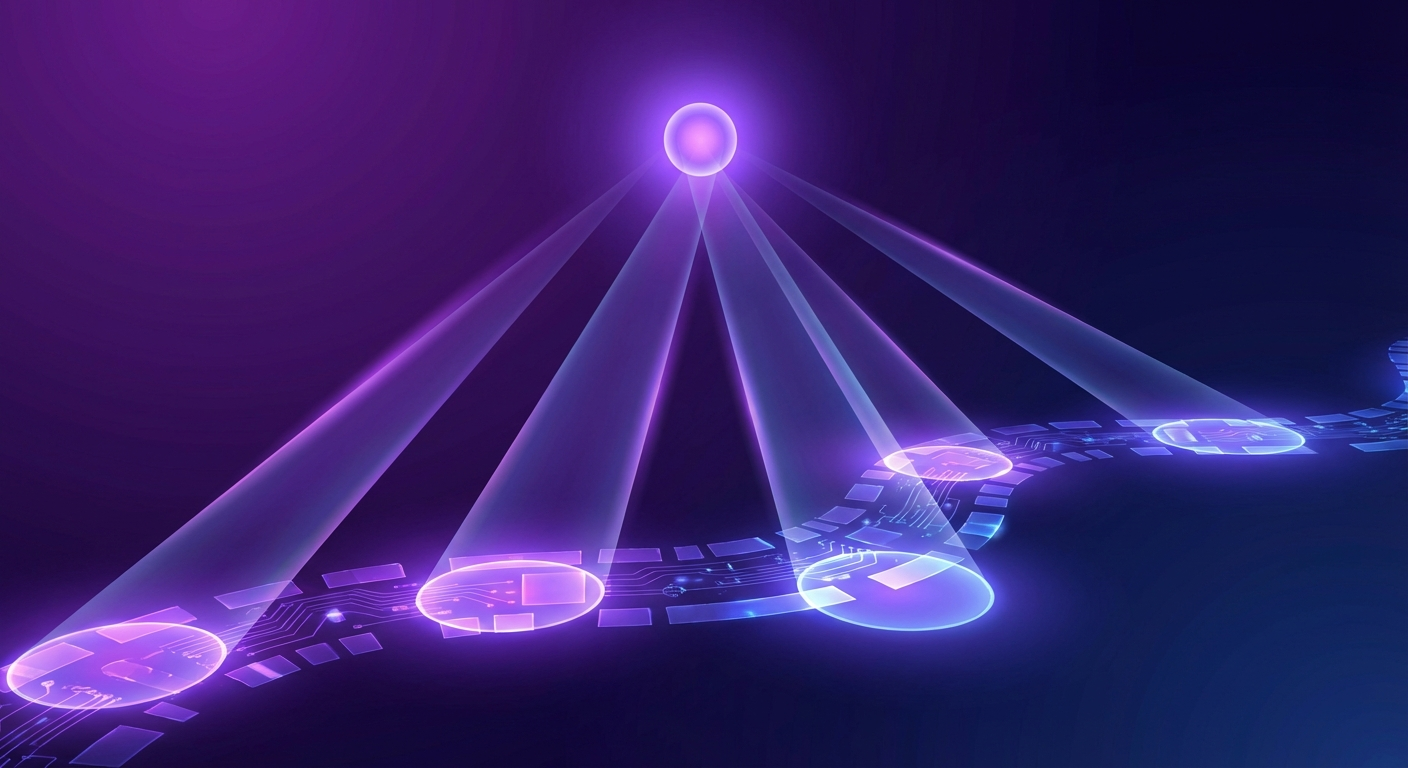
The original Transformer uses 8 attention heads, each operating on 64-dimensional projections (512 / 8 = 64). The total computational cost is similar to single-head attention with full dimensionality, but the representational power is dramatically greater.
“Multi-head attention allows the model to jointly attend to information from different representation subspaces at different positions. With a single attention head, averaging inhibits this.” — Vaswani et al., 2017
The ablation studies in the paper confirmed this design choice: a single attention head (h=1) dropped BLEU scores by nearly a full point, while too many heads (h=32) also degraded performance slightly. Eight heads struck the optimal balance.
The Full Transformer Architecture
The Transformer follows an encoder-decoder structure, but with a design fundamentally different from its predecessors. The encoder maps an input sequence to a continuous representation, and the decoder generates an output sequence one token at a time, attending to both the encoder output and its own previous outputs.
The Encoder Stack
The encoder consists of a stack of N = 6 identical layers. Each layer contains two sub-layers: a multi-head self-attention mechanism, and a position-wise fully connected feed-forward network. Around each sub-layer, the architecture applies a residual connection followed by layer normalization.
The feed-forward network applies two linear transformations with a ReLU activation between them: FFN(x) = max(0, xW1 + b1)W2 + b2. While the same structure is applied at every position, the parameters differ from layer to layer. The inner dimension is 2048, four times the model dimension of 512.

The Decoder Stack
The decoder also has 6 identical layers but adds a third sub-layer: encoder-decoder attention, where queries come from the previous decoder layer and keys/values come from the encoder output. This allows every decoder position to attend over all positions in the input sequence.
Critically, the decoder’s self-attention is masked — positions can only attend to earlier positions, not future ones. This ensures that predictions for position i depend only on known outputs at positions less than i, preserving the autoregressive property needed for generation.
Embeddings and Weight Sharing
The paper introduced an elegant weight-sharing scheme: the same weight matrix is used for both input and output embedding layers, as well as the pre-softmax linear transformation. In the embedding layers, these weights are multiplied by √dmodel to scale them appropriately relative to the positional encodings.
Positional Encoding: Teaching Order to Attention
Since the Transformer contains no recurrence or convolution, it has no inherent notion of token order. The sentence “The cat sat on the mat” and “mat the on sat cat the” would produce identical representations without some notion of position. The solution is positional encoding.
The paper uses sinusoidal functions of different frequencies, added to the input embeddings at the bottom of both encoder and decoder stacks:
PE(pos, 2i) = sin(pos / 100002i/dmodel)
PE(pos, 2i+1) = cos(pos / 100002i/dmodel)
This design has a beautiful mathematical property: for any fixed offset k, the positional encoding at position pos + k can be represented as a linear function of the encoding at position pos. This means the model can easily learn to attend by relative positions, not just absolute ones.
The authors also tested learned positional embeddings and found “nearly identical results.” They chose sinusoidal encodings because they hypothesized these could generalize to sequence lengths longer than any seen during training — a property that has proven important as context windows have expanded from hundreds to millions of tokens.
Experimental Results That Shocked the Field
The Transformer’s results on machine translation benchmarks were not incremental improvements — they represented a paradigm shift in what was achievable.
Translation Benchmarks
| Model | EN→DE BLEU | EN→FR BLEU | Training Cost (FLOPs) |
|---|---|---|---|
| GNMT + RL (Google, 2016) | 24.6 | 39.92 | 2.3 × 10¹⁹ |
| ConvS2S (Facebook, 2017) | 25.16 | 40.46 | 9.6 × 10¹⁸ |
| Best Previous Ensemble | 26.36 | 41.29 | 7.7 × 10¹⁹ |
| Transformer (base) | 27.3 | 38.1 | 3.3 × 10¹⁸ |
| Transformer (big) | 28.4 | 41.8 | 2.3 × 10¹⁹ |
The base Transformer alone — trained for just 12 hours on 8 P100 GPUs — surpassed all previously published models and ensembles on English-to-German. The big model achieved 28.4 BLEU, improving over the best existing result (including ensembles) by more than 2 BLEU points.
On English-to-French, the big Transformer set a new single-model state of the art at 41.8 BLEU, trained in just 3.5 days. Previous models that approached this quality required orders of magnitude more computation.
The Efficiency Revolution
Perhaps even more striking than the quality improvements was the training efficiency. The base Transformer required only 3.3 × 10¹⁸ FLOPs — roughly 3x less computation than ConvS2S and 7x less than Google’s own GNMT system, while delivering superior results. This efficiency-quality combination is what made the Transformer practical for researchers beyond the largest labs.

Ablation Studies: What Really Matters
The paper includes rigorous ablation studies that remain valuable for practitioners today. Key findings include:
- Attention heads: A single head (h=1) degraded performance by 0.9 BLEU. The sweet spot was h=8, though h=16 performed similarly.
- Key dimension: Reducing dk below 64 consistently hurt quality, suggesting that the dot-product compatibility function needs sufficient dimensionality.
- Model size: Larger models (dmodel=1024, dff=4096) with more heads consistently improved results, establishing the scaling trend that would later become central to AI development.
- Dropout: Essential for regularization. Removing dropout degraded performance significantly.
- Positional encoding: Learned embeddings performed “nearly identically” to sinusoidal — the specific encoding method matters less than having position information at all.
Impact and Legacy: From Translation to Everything
The title “Attention Is All You Need” was deliberately provocative, and the AI community took it as a challenge. Within three years, the Transformer had conquered not just natural language processing but virtually every domain of AI.
The Language Model Revolution
In 2018, BERT (Google) used the Transformer encoder to achieve breakthrough results on 11 NLP benchmarks simultaneously. That same year, OpenAI’s GPT used the Transformer decoder to demonstrate that language models could be powerful general-purpose learners. The scaling of these architectures — GPT-2, GPT-3, GPT-4, Claude, Gemini, LLaMA — has driven the current AI revolution.
Beyond Language
The Transformer’s impact extends far beyond text. Vision Transformers (ViT) demonstrated in 2020 that attention-based models could match or exceed convolutional neural networks on image classification. AlphaFold 2 used Transformers to solve the 50-year-old protein folding problem. DALL-E, Stable Diffusion, and Midjourney use Transformer components for image generation.
Today, Transformers power applications across document understanding, code generation, music composition, drug discovery, robotics, and scientific research. The architecture’s flexibility and scalability have made it the default choice for nearly any task involving structured data.
The Authors’ Trajectories
The eight co-authors of the paper have gone on to shape the AI industry. Aidan Gomez co-founded Cohere, building enterprise LLMs. Illia Polosukhin co-founded NEAR Protocol. Noam Shazeer co-founded Character.AI before returning to Google. Llion Jones co-founded Sakana AI. Their collective impact reflects the paper’s foundational importance.
Practical Implications for Business and Technology
Understanding the Transformer architecture is no longer just for researchers — it’s essential knowledge for anyone building or evaluating AI-powered products and services.
Why Scaling Works
The Transformer’s architecture enables predictable scaling: more data, more compute, and more parameters reliably produce better models. This is the foundation of scaling laws that companies like OpenAI, Anthropic, and Google use to plan multi-billion-dollar training runs. The parallelizable nature of self-attention means that throwing more GPUs at the problem actually works — unlike sequential architectures where adding hardware has diminishing returns.
The Quadratic Challenge
The one well-known limitation of standard self-attention is its O(n²) complexity with sequence length. Processing a sequence of 100,000 tokens requires 10 billion attention computations per layer. This has spawned an entire field of efficient attention research — FlashAttention, sparse attention, linear attention, and ring attention — all working to extend context windows while managing this quadratic cost.
Transformers and Interactive Experiences
At Libertify, the Transformer architecture powers many of the AI capabilities that transform static documents into interactive experiences. From understanding document structure to generating summaries and interactive elements, the attention mechanism’s ability to capture relationships across long documents makes modern document intelligence possible.
Frequently Asked Questions
What is the Attention Is All You Need paper about?
The “Attention Is All You Need” paper, published at NeurIPS 2017 by Vaswani et al. from Google, introduces the Transformer architecture. It replaces recurrent and convolutional neural networks with a model based entirely on attention mechanisms, achieving state-of-the-art results in machine translation while being significantly faster to train.
What is self-attention in transformers?
Self-attention (also called intra-attention) is a mechanism that relates different positions within a single sequence to compute a representation. Each token computes attention scores with every other token in the sequence, allowing the model to capture long-range dependencies in constant time — unlike RNNs which require O(n) sequential steps.
Why did the Transformer replace RNNs and LSTMs?
The Transformer replaced RNNs and LSTMs because it processes all positions in a sequence simultaneously (in parallel) rather than sequentially. This dramatically reduces training time while also providing shorter paths for learning long-range dependencies. The Transformer achieved better translation quality than RNN-based models at a fraction of the computational cost.
What is multi-head attention and why does it matter?
Multi-head attention runs multiple attention operations in parallel, each with different learned projection matrices. With 8 heads (as in the original Transformer), the model can simultaneously attend to information from different representation subspaces at different positions. This is far more powerful than a single attention operation, which tends to average out different types of information.
How does positional encoding work in transformers?
Since the Transformer has no recurrence or convolution, it needs positional encodings to understand word order. The original paper uses sinusoidal functions of different frequencies, where each dimension of the encoding corresponds to a sinusoid. This allows the model to learn relative positions because for any fixed offset k, the positional encoding at position pos+k can be expressed as a linear function of the encoding at position pos.
Transform any document into an interactive experience
Upload a PDF, report, or presentation. Libertify turns it into something your audience will actually read — and remember.