The WEF Global Risks Report 2025: Navigating a Fractured World on the Brink
Table of Contents
- Executive Summary: A World Fracturing Along Every Axis
- The 2025 Immediate-Term Risk Landscape: Conflict, Chaos, and Information Warfare
- The Misinformation Crisis: AI-Powered Deception at Scale
- Environmental Risks: The 10-Year Horizon Demands Radical Action
- Geopolitical Risks: The New Era of Great-Power Competition
- Economic Risks: The Surprising Absence — and Hidden Dangers
- Technology Risks: AI as Both Salvation and Threat
- Societal Risks: Polarization, Migration, and the Erosion of Trust
- Global Risks 2035: The Point of No Return
- Implications for Business Leaders and Policymakers
- Making Complex Reports Accessible: The Libertify Approach
- Conclusion: The Urgency of Informed Action
📌 Key Takeaways
- 52% of experts expect an unsettled world over the next two years — pessimism deepens dramatically over the 10-year horizon.
- State-based armed conflict is the #1 immediate concern in 2025, with 23% of respondents selecting it as the top threat.
- Misinformation and disinformation leads the 2-year risk outlook for the second consecutive year, fueled by AI-generated content.
- Environmental risks dominate the 10-year horizon: extreme weather (#1), biodiversity loss (#2), Earth system changes (#3), resource shortages (#4).
- No economic risks appear in the short-term top 10 — a surprising shift — but government debt remains a structural concern.
- Technology risks like cyber espionage and adverse AI outcomes are rising fast in both 2-year and 10-year rankings.
Executive Summary: A World Fracturing Along Every Axis
Released on January 15, 2025 — just days before the World Economic Forum’s annual meeting in Davos themed “Collaboration for the Intelligent Age” — the 20th edition of the Global Risks Report delivers a sobering message: the global landscape is fracturing across geopolitical, environmental, societal, economic, and technological domains simultaneously.
Based on the Global Risks Perception Survey (GRPS) 2024-2025, which gathered insights from over 900 experts spanning academia, business, government, international organizations, and civil society, the report assesses risks across three distinct timeframes: the immediate term (2025), the medium term (2027), and the long term (2035).
“The world has changed profoundly over the last 20 years and will continue to do so in unpredictable ways. Yet, in examining the trajectory of the risks foreseen over the last two decades, it is clear that there is no viable alternative to multilateral solutions.” — Saadia Zahidi, Managing Director, World Economic Forum
The overarching mood? “Gloom is the overarching adjective that describes the overall state of things,” said Mark Elsner, Head of the Global Risks Initiative at the WEF. A majority of respondents — 52% — anticipate an unsettled global outlook over the short term, while pessimism about the longer-term trajectory is significantly more pronounced.
The 2025 Immediate-Term Risk Landscape: Conflict, Chaos, and Information Warfare
State-Based Armed Conflict: The Defining Threat of 2025
When asked to identify the single most pressing global risk in 2025, the answer was unequivocal: state-based armed conflict. Nearly 23% of respondents selected it as the number one threat — a dramatic escalation from just two years ago, when armed conflict didn’t even appear in the top risk rankings.
The destabilizing consequences of Russia’s invasion of Ukraine, ongoing conflicts in the Middle East (including the Israel-Gaza war and broader regional instability), and the devastating civil war in Sudan are reshaping the geopolitical order. These are not isolated incidents — they represent a systemic shift toward great-power competition and the erosion of the rules-based international order.
The second most cited immediate risk was extreme weather events (14% of respondents), followed by geoeconomic confrontation (8%). This trio — conflict, climate, and economic rivalry — forms the core threat matrix for 2025.
The Full 2-Year Risk Rankings (2025–2027)
The two-year outlook provides the most actionable risk intelligence for business leaders and policymakers:
| Rank | Risk | Category |
|---|---|---|
| 1 | Misinformation and disinformation | Technological |
| 2 | Extreme weather events | Environmental |
| 3 | State-based armed conflict | Geopolitical |
| 4 | Societal polarization | Societal |
| 5 | Cyber espionage and warfare | Technological |
| 6 | Pollution | Environmental |
| 7 | Lack of economic opportunity | Economic |
| 8 | Geoeconomic confrontation | Geopolitical |
| 9 | Involuntary migration | Societal |
| 10 | Adverse outcomes of AI technologies | Technological |
What’s notable is the composition: this list spans all five risk categories (geopolitical, environmental, societal, technological, economic), confirming that the world faces not a single crisis but a polycrisis — multiple interconnected threats amplifying each other.
The Misinformation Crisis: AI-Powered Deception at Scale
For the second year running, misinformation and disinformation tops the medium-term risk outlook. This is not a repetition — the threat has intensified. The severity score increased year-on-year, reflecting growing alarm about the intersection of artificial intelligence and information warfare.
Several converging trends are driving this:
- Generative AI has democratized deception. Creating convincing deepfakes, synthetic text, and fabricated evidence is now accessible to virtually anyone. The cost of producing disinformation has collapsed while its quality has soared.
- Platform policy changes are amplifying the problem. The retreat from fact-checking on major social media platforms — including Meta’s 2025 decision to end its third-party fact-checking program — has removed critical guardrails.
- Geopolitical actors are weaponizing information. State-sponsored disinformation campaigns are targeting elections, public health, and social cohesion across democracies worldwide.
- Trust is collapsing. The cumulative effect is a crisis of epistemic trust — people increasingly cannot distinguish fact from fiction, and default to tribal information sources.
The WEF report identifies a dangerous feedback loop: misinformation drives societal polarization, which in turn creates fertile ground for more misinformation. For the first time, adverse outcomes of AI was selected by respondents as the most interconnected risk with misinformation — meaning AI is seen as both an enabler and accelerant of the information crisis.
Want to see AI insights in action? Transform any report into an interactive experience.
Environmental Risks: The 10-Year Horizon Demands Radical Action
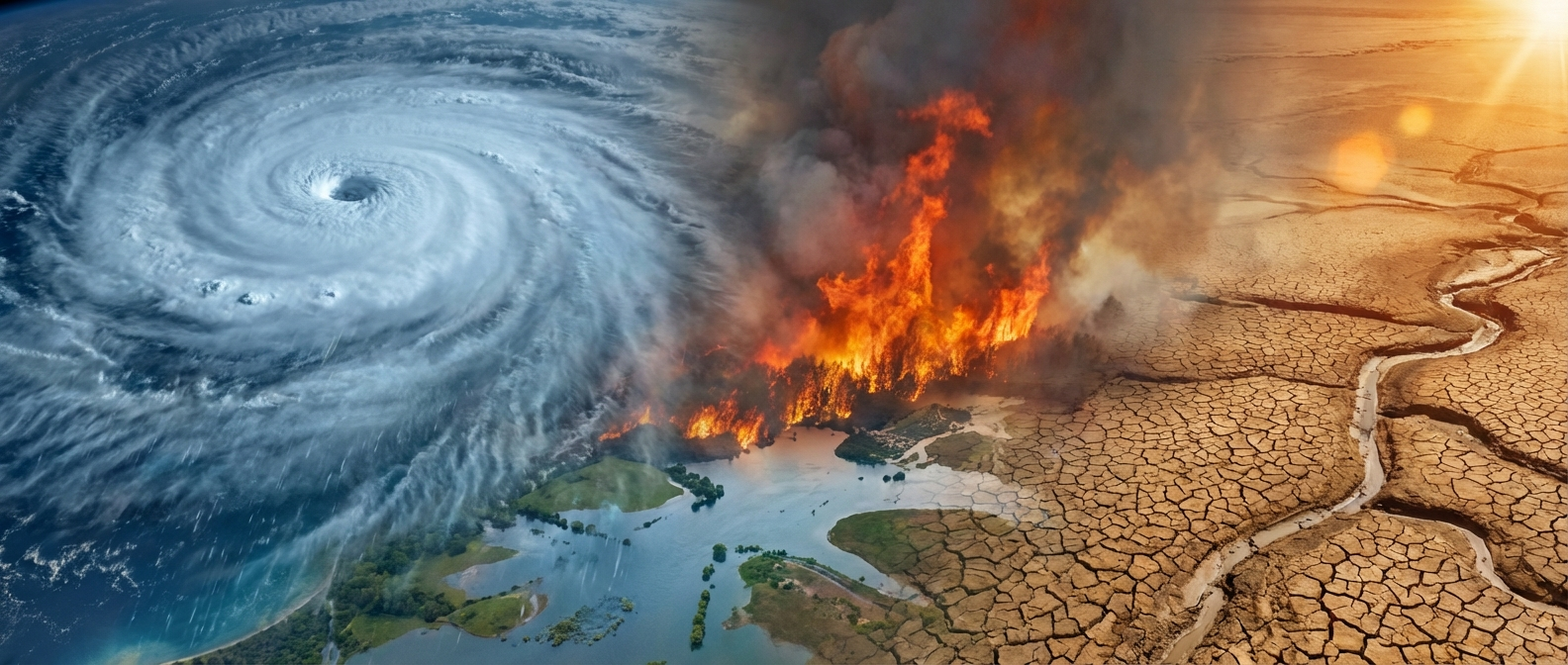
Five of the Top Ten Long-Term Risks Are Environmental
If the 2-year outlook is dominated by geopolitical and technological chaos, the 10-year horizon tells a different story: the planet itself is at risk. The long-term risk rankings (2025–2035) are dominated by environmental threats:
| Rank | Risk (10-Year Horizon) | Category |
|---|---|---|
| 1 | Extreme weather events | 🌍 Environmental |
| 2 | Biodiversity loss & ecosystem collapse | 🌍 Environmental |
| 3 | Critical changes to Earth systems | 🌍 Environmental |
| 4 | Natural resource shortages | 🌍 Environmental |
| 5 | Misinformation & disinformation | 💻 Technological |
| 6 | Adverse outcomes of AI technologies | 💻 Technological |
| 7 | Involuntary migration | 👥 Societal |
| 8 | Societal polarization | 👥 Societal |
| 9 | Geoeconomic confrontation | ⚔️ Geopolitical |
| 10 | Pollution | 🌍 Environmental |
The consistency of environmental dominance across multiple editions is striking. For four consecutive years, the WEF has ranked extreme weather, biodiversity loss, and pollution among the most severe long-term threats.
2024: The Warmest Year on Record
The report’s environmental warnings are grounded in hard data. 2024 was officially the warmest year on record, with global average temperatures exceeding 1.5°C above pre-industrial levels for the first time. The consequences are already visible: record-breaking wildfires in Canada and southern Europe, unprecedented flooding in East Africa and South Asia, intensifying hurricane seasons, and accelerating ice sheet melt. The economic toll of climate-related disasters exceeded $300 billion in 2024 alone.
Biodiversity: From Obscurity to Existential Threat
Perhaps the most remarkable trajectory in the report’s 20-year history is the rise of biodiversity loss. In 2009, respondents ranked it #37 out of all risks. In 2025, it sits at #2 in the 10-year horizon — an extraordinary shift reflecting both scientific consensus and visible ecological degradation. The Living Planet Index shows a 69% average decline in monitored wildlife populations since 1970.
The report notes a generational divide: respondents under 30 rate environmental risks even more severely, with younger experts ranking pollution as the #3 most severe risk in 2035 — the highest of any age group surveyed.
Geopolitical Risks: The New Era of Great-Power Competition
The Weaponization of Economic Interdependence
The weaponization of economic interdependence — trade restrictions, sanctions regimes, investment controls, and financial system leverage — has become a defining feature of 21st-century geopolitics. Key manifestations include:
- US-China technological decoupling — semiconductor export controls, AI restrictions, and competing technology standards
- Sanctions regimes — comprehensive financial sanctions on Russia, expanding secondary sanctions, and the weaponization of SWIFT
- Resource nationalism — critical mineral export controls by China, Indonesia, and others
- Trade bloc fragmentation — the shift from globalization to “friendshoring” and regional trade blocs
For businesses, this means supply chain redesign is no longer optional. The era of frictionless global trade is over, replaced by geopolitical risk premiums, compliance complexity, and strategic vulnerability.
Economic Risks: The Surprising Absence — and Hidden Dangers
One of the most surprising findings: no economic risks appear in the 2-year top 10. Both inflation and economic downturn have slipped sharply, reflecting a perception that the worst of the post-pandemic shock has passed.
However, this apparent calm masks structural vulnerabilities:
- Government debt levels are at historic highs — global government debt exceeded $100 trillion in 2024, with the IMF projecting continued deterioration.
- Economic downturn still ranks 6th among overarching global risks, suggesting underlying fragility remains.
- Asset bubble risks persist, particularly in AI-related equities and real estate markets.
- The cost-of-living crisis continues to affect emerging economies disproportionately, even as headline inflation moderates in advanced economies.
“Ignoring the impacts of extreme weather, climate maladaptation, and biodiversity degradation is no longer an option; the effects are already visible on the bottom line.” — Doron Telem, National ESG Leader, KPMG Canada
Ready to make your documents more engaging? See how Libertify transforms static content.
Technology Risks: AI as Both Salvation and Threat

The rise of AI as a global risk factor is a defining narrative of the 2025 report. While AI promises transformative benefits, the report identifies several vectors of concern:
- Autonomous weapons systems — AI-powered military applications lowering the threshold for conflict
- Labor market disruption — automation displacing workers faster than retraining systems can adapt
- Algorithmic bias — AI systems perpetuating and amplifying existing inequalities
- Concentration of power — a small number of tech companies controlling AI infrastructure
- AI-enabled surveillance — state and corporate surveillance capabilities expanding dramatically
Adverse outcomes of AI ranks #6 in the 10-year horizon — up from lower positions in previous editions. The CrowdStrike outage of 2024 — which disrupted airlines, banks, and hospitals worldwide — underscored how technology failures can cascade through interconnected systems.
Societal Risks: Polarization, Migration, and the Erosion of Trust
Societal polarization appears in the top 5 across both horizons. The report identifies a self-reinforcing cycle: political polarization drives policy gridlock → undermines institutional effectiveness → erodes public trust → deepens polarization.
This is particularly dangerous in the context of elections — 2024 was the largest election year in history, with more than 4 billion people in over 60 countries going to the polls. The combination of polarization and misinformation creates conditions where electoral outcomes are contested regardless of legitimacy.
Involuntary migration is both a consequence and amplifier of other risks. The UNHCR reported over 120 million forcibly displaced people globally by mid-2024. Climate change, armed conflict, and economic desperation are driving migration flows at levels not seen since World War II.
Global Risks 2035: The Point of No Return

The report’s most forward-looking section examines the risk landscape in 2035 if current trends continue without significant intervention:
- Population aging: People aged 65+ expected to increase 36%, from 857 million (2025) to 1.2 billion (2035). Super-aging societies face cascading risks from healthcare costs to labor shortages.
- Environmental tipping points: Without dramatic emissions reductions, several Earth system tipping points — permafrost thaw, Atlantic circulation disruption, Amazon dieback — become likely or irreversible.
- AI governance gap: The pace of AI development outstripping regulatory and ethical frameworks, creating a governance deficit.
- Democratic recession: Continued erosion of democratic norms could accelerate the shift toward authoritarian governance models.
Don’t let critical insights get buried in PDFs. Make them interactive with Libertify.
Implications for Business Leaders and Policymakers
The report’s findings translate into clear strategic imperatives:
- Build geopolitical intelligence capabilities. Organizations need real-time risk assessment, scenario planning, and supply chain stress-testing for geopolitical disruptions.
- Invest in information resilience. The misinformation threat requires proactive brand protection and crisis communication designed for the AI era.
- Accelerate climate adaptation. Waiting for regulatory mandates is no longer viable — integrate climate risk into core strategy.
- Diversify technology dependencies. Single points of failure in technology infrastructure are unacceptable risks.
- Prepare for regulatory complexity. Geoeconomic fragmentation means navigating multiple, potentially conflicting regulatory regimes.
“Integrating climate and biodiversity considerations into core business strategies is fundamental for long-term resilience and corporate sustainability.” — Doron Telem, KPMG Canada
Making Complex Reports Accessible: The Libertify Approach
At 100+ pages of dense analysis, the WEF Global Risks Report is exactly the kind of document that matters enormously but often goes unread by the people who need it most. Decision-makers are time-constrained. Key findings get lost in the volume. Critical nuances are missed.
This is precisely the problem Libertify solves. By transforming complex documents — whether they’re risk reports, research papers, pitch decks, or policy briefs — into interactive, self-explaining experiences, Libertify ensures that the insights within these documents actually reach and engage their intended audience.
The interactive experience embedded at the top of this article transforms the full WEF Global Risks Report 2025 into a navigable, digestible format that lets you explore the findings at your own pace. In a world where misinformation is the top short-term risk, making authoritative information more accessible isn’t just a convenience — it’s a necessity.
Conclusion: The Urgency of Informed Action
The 20th edition of the WEF Global Risks Report presents a world where the margin for error is shrinking. Armed conflicts are reshaping the geopolitical order. Misinformation is eroding the foundations of democratic society. Environmental degradation is approaching irreversible tipping points. And technological change is outpacing our ability to govern it.
The report’s message is not one of despair, but of urgency. The risks are interconnected, and so are the solutions. Investment in climate adaptation reduces migration pressure. Strengthening information ecosystems bolsters democratic resilience. Building technology governance frameworks mitigates both AI risk and cyber threats.
The data from 900+ experts is clear: the window for effective action is narrowing. The time for informed, decisive, collaborative response is now.
Frequently Asked Questions
What are the top global risks in 2025 according to the WEF?
According to the WEF Global Risks Report 2025, the top immediate risk is state-based armed conflict (cited by 23% of respondents). The top 2-year risks are: misinformation/disinformation (#1), extreme weather (#2), armed conflict (#3), societal polarization (#4), and cyber espionage (#5).
What are the biggest long-term risks for 2035?
Environmental risks dominate the 10-year horizon: extreme weather events (#1), biodiversity loss (#2), Earth system changes (#3), and natural resource shortages (#4). The report warns that several tipping points — permafrost thaw, Atlantic circulation disruption, Amazon dieback — could become irreversible without dramatic action.
How does AI contribute to global risks in the WEF report?
AI amplifies global risks in two key ways: first, generative AI has democratized disinformation, making misinformation the #1 medium-term risk for the second consecutive year. Second, adverse outcomes of AI technologies rank #10 in the 2-year outlook, reflecting concerns about the AI governance gap as development outpaces regulation.
How many experts contributed to the WEF Global Risks Report 2025?
The report is based on the Global Risks Perception Survey (GRPS) 2024-2025, which gathered insights from over 900 experts spanning academia, business, government, international organizations, and civil society. It is the 20th edition of the report.