GPT-4 Technical Report: Inside OpenAI’s Most Capable Language Model
The GPT-4 technical report represents one of the most significant milestones in artificial intelligence research. Released by OpenAI, this document details a large multimodal model that achieves human-level performance on professional and academic benchmarks — including passing a simulated bar exam in the top 10% of test takers. But what exactly makes GPT-4 different, and what does its technical architecture reveal about the future of AI? In this comprehensive guide, we break down every major finding from the original technical report, from predictable scaling laws to safety alignment, giving you a complete understanding of what’s under the hood.
Table of Contents
- What Is GPT-4? A Technical Overview
- Predictable Scaling: Forecasting AI Performance
- GPT-4 Benchmark Performance on Professional Exams
- Multimodal Capabilities: Vision Meets Language
- Multilingual Performance and MMLU Results
- Safety, Alignment, and RLHF
- GPT-4 Limitations and Known Weaknesses
- Impact on Industry and Enterprise AI Adoption
- GPT-4 vs GPT-3.5: A Direct Comparison
- Future Implications for AI Research
- Frequently Asked Questions
📌 Key Takeaways
- Bar Exam in the Top 10% — GPT-4 scores 298/400 on the Uniform Bar Exam, vs. GPT-3.5’s bottom-10% performance at 213/400.
- Multimodal Model — GPT-4 accepts both image and text inputs, enabling visual reasoning tasks previously impossible for language models.
- Predictable Scaling — OpenAI predicted GPT-4’s performance from models trained with 1,000–10,000× less compute, a breakthrough for AI safety planning.
- 24 of 26 Languages — GPT-4 surpasses English-language MMLU state-of-the-art in 24 out of 26 languages tested, demonstrating deep multilingual capability.
- Safety-First Approach — RLHF alignment, 50+ domain expert red teamers, and a model-assisted safety pipeline reduced harmful outputs by 82%.
- Acknowledged Limitations — OpenAI transparently documents hallucination risks, context window constraints, and competitive programming weaknesses.
What Is GPT-4? A Technical Overview
GPT-4 is a large-scale, multimodal model developed by OpenAI that represents a fundamental leap in artificial intelligence capabilities. Built on the Transformer architecture — the same foundational framework that powers modern language models — GPT-4 was pre-trained to predict the next token in a document using both publicly available data and data licensed from third-party providers.
What sets the GPT-4 technical report apart from previous OpenAI publications is both what it reveals and what it deliberately omits. In a departure from earlier practice, OpenAI chose not to disclose the model’s architecture details, including model size, hardware specifications, training compute, dataset construction, or training methodology. This decision, driven by competitive and safety considerations, marked a significant shift in AI research transparency.
The model was subsequently fine-tuned using Reinforcement Learning from Human Feedback (RLHF), a technique that aligns the model’s outputs with human preferences and values. This post-training alignment process resulted in measurable improvements on factuality and adherence to desired behavior, though as the report notes, the core capabilities emerged primarily from pre-training.

At its core, GPT-4 is designed to be a general-purpose model capable of handling a vast range of tasks — from legal analysis and medical diagnostics to creative writing and code generation. The full technical report on arXiv runs to over 100 pages including appendices and a comprehensive system card detailing safety evaluations.
Explore the complete GPT-4 Technical Report as an interactive experience — highlights, navigation, and AI-powered summaries built in.
Predictable Scaling: Forecasting AI Performance
One of the most groundbreaking revelations in the GPT-4 technical report is OpenAI’s achievement in predictable scaling. A core component of the project involved developing deep learning infrastructure and optimization methods that behave predictably across a wide range of scales. This allowed the team to accurately predict aspects of GPT-4’s performance based on models trained with no more than 1/1,000th the compute.

Loss Prediction
Following established neural scaling laws, OpenAI fitted a power law with an irreducible loss term: L(C) = aCb + c, using models trained with at most 10,000× less compute than GPT-4. The prediction was made shortly after the training run started, without using any partial results, and the fitted scaling law predicted GPT-4’s final loss with remarkable accuracy.
Capability Prediction on HumanEval
Beyond simple loss prediction, the team developed methodology to predict more interpretable capability metrics. On the HumanEval dataset — which measures the ability to synthesize Python functions of varying complexity — they successfully predicted GPT-4’s pass rate by extrapolating from models trained with at most 1,000× less compute.
This capability has profound implications for the future of enterprise AI adoption. If researchers can reliably forecast model capabilities before investing billions in training compute, it fundamentally changes the economics and safety calculus of large-scale AI development.
“We believe that accurately predicting future capabilities is important for safety. Going forward we plan to refine these methods and register performance predictions across various capabilities before large model training begins.” — GPT-4 Technical Report
GPT-4 Benchmark Performance on Professional Exams
The most headline-grabbing aspect of the GPT-4 technical report is its performance on professional and academic examinations. GPT-4 was tested on a diverse set of benchmarks, including simulating exams originally designed for humans, with no specific training for these evaluations.
| Exam | GPT-4 Score | Percentile | GPT-3.5 Score | GPT-3.5 Percentile |
|---|---|---|---|---|
| Uniform Bar Exam | 298/400 | ~90th | 213/400 | ~10th |
| LSAT | 163 | ~88th | 149 | ~40th |
| SAT Reading & Writing | 710/800 | ~93rd | 670/800 | ~87th |
| SAT Math | 700/800 | ~89th | 590/800 | ~70th |
| GRE Verbal | 169/170 | ~99th | 154/170 | ~63rd |
| GRE Quantitative | 163/170 | ~80th | 147/170 | ~25th |
| USABO Biology | 87/150 | 99–100th | 43/150 | 31–33rd |
| Medical Knowledge (MKSA) | 75% | — | 53% | — |
| AP Calculus BC | 4/5 | 43–59th | 1/5 | 0–7th |
| AP Chemistry | 4/5 | 71–88th | 2/5 | 22–46th |

The bar exam result is particularly striking. GPT-4 achieved a score of 298/400 on the Uniform Bar Exam (MBE+MEE+MPT), placing it around the 90th percentile of test takers. This represents a massive improvement over GPT-3.5, which scored just 213/400 — roughly the 10th percentile. The model also excelled in specialized domains: 99th percentile on the USABO Biology Semifinal, 92% on sommelier theory knowledge, and scores of 5/5 on multiple Advanced Placement exams.
However, the report is careful to note that GPT-4 still struggles with certain domains. On Codeforces competitive programming, it achieved a rating of 392 — below the 5th percentile. This reveals an important asymmetry: while GPT-4 excels at knowledge-intensive tasks requiring broad understanding, it has clear weaknesses in tasks requiring deep, novel algorithmic reasoning.
Want to understand how AI benchmarks connect to real enterprise value? Read our analysis of the McKinsey State of AI Report.
Multimodal Capabilities: Vision Meets Language
GPT-4 introduced a paradigm shift by accepting both image and text inputs while producing text outputs. This multimodal capability means the model can analyze photographs, diagrams, charts, and screenshots — then reason about their contents in natural language.
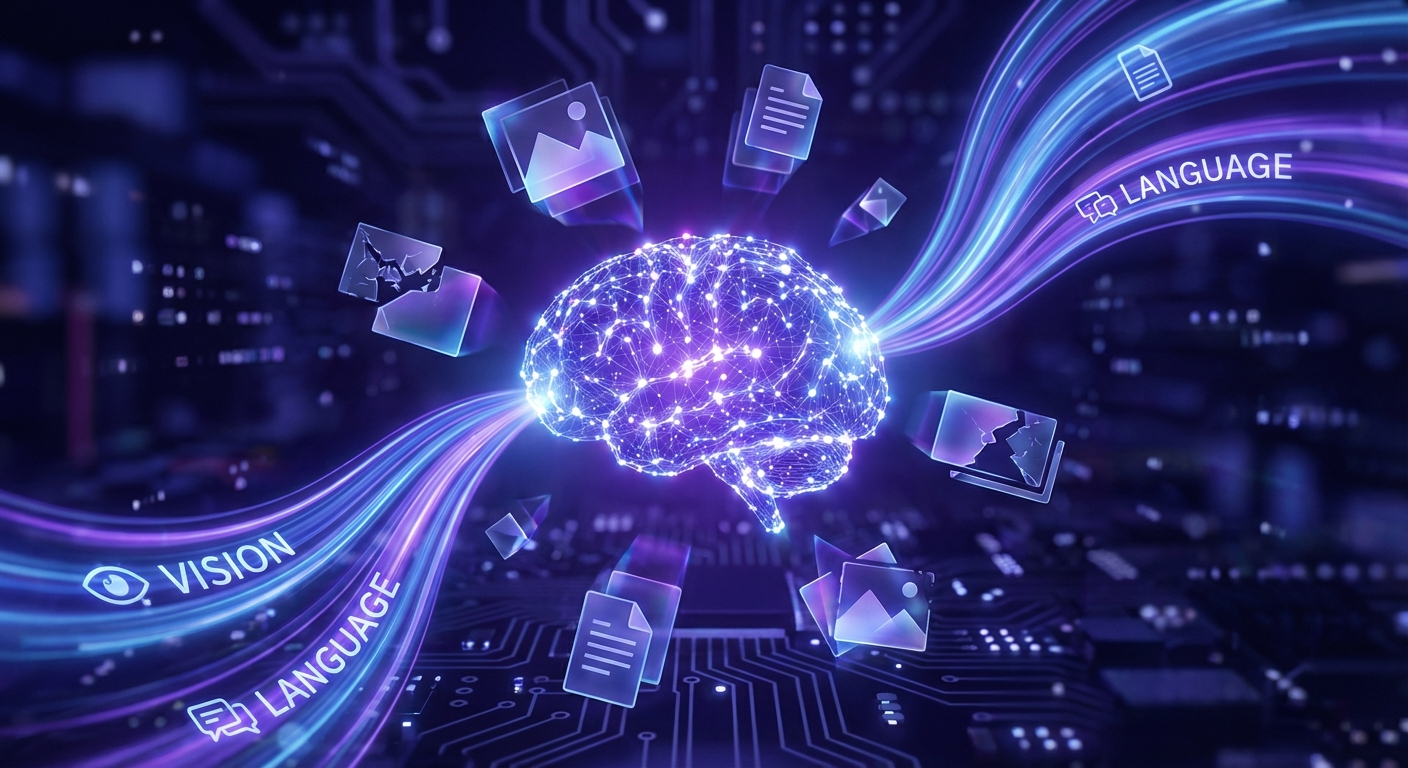
In the technical report, OpenAI demonstrated GPT-4’s visual reasoning across various scenarios: explaining the humor in memes, interpreting complex data visualizations, reading handwritten text, and analyzing scientific diagrams. The vision capabilities were evaluated on standardized benchmarks as well — GPT-4 achieved the same high scores on many exams whether or not visual input was provided, with notable improvements on vision-specific tasks.
The implications for enterprise applications are significant. Document understanding, visual inspection, medical imaging analysis, and accessibility tools all become viable use cases with a single unified model. As explored in our guide on EU AI Act compliance, multimodal AI systems require particular attention under the new regulatory framework, especially when deployed in high-risk domains.
Multilingual Performance and MMLU Results
On the Massive Multitask Language Understanding (MMLU) benchmark — a suite of multiple-choice problems spanning 57 subjects — GPT-4 not only outperforms all existing models by a considerable margin in English but demonstrates extraordinary multilingual capability.
To test GPT-4’s cross-lingual ability, OpenAI translated the MMLU benchmark into 26 languages using Azure Translate. The result was striking: GPT-4 surpasses the English-language state-of-the-art in 24 of 26 languages considered. This means that GPT-4 answering questions in languages like Mandarin, Japanese, Italian, or Ukrainian performs better than the previous best English-only system.
This finding has profound implications for global AI deployment. Organizations operating across multiple markets can leverage a single model for knowledge-intensive tasks regardless of language, reducing the need for language-specific model development. According to the UK AI Safety Institute, multilingual capabilities also introduce unique safety challenges that require careful evaluation.
Safety, Alignment, and RLHF
The GPT-4 technical report dedicates extensive attention to safety and alignment — acknowledging that the model’s capabilities create “significant and novel safety challenges.” OpenAI’s approach involved multiple layers of protection:

Reinforcement Learning from Human Feedback (RLHF)
GPT-4 underwent post-training alignment using RLHF, where human trainers rated model outputs to guide behavior. Interestingly, the report reveals that RLHF’s impact on raw capability is limited — the base model performs equally well on multiple-choice benchmarks. Instead, RLHF primarily improves the model’s ability to follow instructions, refuse harmful requests, and produce more factual responses.
Red Teaming and Adversarial Testing
OpenAI engaged over 50 domain experts — including specialists in AI alignment, cybersecurity, biorisk, and international security — to adversarially test GPT-4. This red teaming identified potential risks around:
- Generating harmful content (bias, disinformation, manipulation)
- Providing dangerous technical knowledge (cybersecurity, biological agents)
- Over-reliance risks where users trust incorrect outputs
- Privacy and data leakage from training data
- Proliferation risks in dual-use domains
The safety improvements were substantial. Compared to GPT-3.5, the RLHF-trained GPT-4 produces responses compliant with OpenAI’s safety policies 82% more often, and generates “disallowed content” 29% less frequently. These numbers, while significant, also underscore that perfect safety remains an unsolved challenge.
See how global risk experts are assessing AI’s impact on society — explore the WEF Global Risks Report interactively.
GPT-4 Limitations and Known Weaknesses
To its credit, the GPT-4 technical report is transparent about the model’s limitations — a practice that serves both the research community and potential deployers:
- Hallucinations: GPT-4 still generates plausible-sounding but factually incorrect information. While reduced compared to predecessors, this remains one of the most significant deployment risks.
- Limited Context Window: The model has a finite context window that constrains its ability to process very long documents or maintain extended conversations.
- No Learning from Experience: GPT-4 does not update its knowledge or improve based on individual interactions during inference — each conversation starts from the same base state.
- Competitive Programming Weakness: With a Codeforces rating of 392 (below 5th percentile), GPT-4 struggles with novel algorithmic challenges that require creative problem-solving beyond pattern matching.
- Confidence Calibration: The model can be confidently wrong, expressing high certainty about incorrect answers without indicating uncertainty.
- Reasoning Chains: While capable of multi-step reasoning, GPT-4 can make logical errors that compound through longer reasoning chains, particularly in mathematical proofs.
These limitations are not merely academic — they have real-world consequences for deployment decisions. As detailed in our analysis of the state of crypto and blockchain technology, AI hallucination risks are particularly acute in high-stakes financial domains.
Impact on Industry and Enterprise AI Adoption
The GPT-4 technical report catalyzed a transformation in how enterprises approach AI adoption. Key industry impacts include:
Legal and Professional Services
GPT-4’s bar exam performance — scoring in the 90th percentile — immediately triggered investments in AI-powered legal research, contract analysis, and compliance tools. Law firms began piloting GPT-4 for document review, case research, and brief drafting, with some reporting 40–60% time savings on routine legal tasks.
Healthcare and Medical AI
With 75% accuracy on the Medical Knowledge Self-Assessment Program and strong performance across biology and chemistry benchmarks, GPT-4 opened new possibilities for medical AI. The National Institutes of Health and other research institutions have since explored GPT-4’s potential for literature review, diagnostic support, and patient communication.
Education and Assessment
GPT-4’s performance across AP exams, SAT, GRE, and other standardized tests raised fundamental questions about the future of human assessment. Educational institutions worldwide began reconsidering exam formats and assessment methodologies in light of AI capabilities.
GPT-4 vs GPT-3.5: A Direct Comparison
The improvement from GPT-3.5 to GPT-4 represents one of the largest capability jumps in AI history. Here is a comparative analysis across key dimensions:
| Dimension | GPT-3.5 | GPT-4 | Improvement |
|---|---|---|---|
| Bar Exam | ~10th percentile | ~90th percentile | +80 percentile points |
| LSAT | ~40th percentile | ~88th percentile | +48 percentile points |
| GRE Verbal | ~63rd percentile | ~99th percentile | +36 percentile points |
| Multimodal Input | Text only | Text + Image | New capability |
| MMLU (English) | 70.0% | 86.4% | +16.4 points |
| Safety Compliance | Baseline | +82% improvement | Significant reduction |
| Disallowed Content | Baseline | −29% generation | Safer outputs |
| LeetCode Easy | 12/41 | 31/41 | +19 problems |
| LeetCode Medium | 8/80 | 21/80 | +13 problems |
The pattern is clear: GPT-4 doesn’t just incrementally improve on GPT-3.5 — it fundamentally closes the gap between AI and human-level performance across a wide range of professional domains. The jump from 10th to 90th percentile on the bar exam alone represents a qualitative shift in the model’s reasoning capabilities.
Future Implications for AI Research
The GPT-4 technical report establishes several precedents that continue to shape AI research and development:
Scaling Laws as Research Tools
The demonstration that model performance can be predicted from much smaller training runs opens the door to more efficient and safer AI development. Rather than training massive models blindly, researchers can use scaling laws to estimate capabilities, plan safety measures, and make informed decisions about whether to proceed with large-scale training.
The Transparency Debate
By withholding architecture details, OpenAI ignited a fierce debate about transparency in AI research. Critics argued that this limits reproducibility and independent safety evaluation. Supporters contended that disclosing details of increasingly powerful systems creates proliferation risks. This tension remains unresolved and is now a central question in AI governance frameworks worldwide.
The RLHF Insight
Perhaps the most underappreciated finding is that RLHF has limited impact on raw capabilities — the base model is nearly as capable on benchmarks. This suggests that alignment techniques work more as behavioral shaping than capability enhancement, a crucial insight for the AI safety community pursuing alignment solutions that don’t sacrifice model capability.
From Language Models to Foundation Models
GPT-4’s multimodal capabilities — accepting both text and image inputs — signaled a broader industry shift from pure language models to general-purpose foundation models. Today, this trajectory has expanded to include audio, video, and tool use, as documented in our analysis of DeepSeek-R1’s pure reinforcement learning approach to AI reasoning.
Discover how AI is reshaping every industry — explore the Stanford AI Index Report for the latest data on adoption and impact.
Frequently Asked Questions About the GPT-4 Technical Report
What is GPT-4 and how does it differ from GPT-3.5?
GPT-4 is OpenAI’s large multimodal model that can accept both image and text inputs and produce text outputs. Unlike GPT-3.5, GPT-4 passes a simulated bar exam in the top 10% of test takers (vs. bottom 10% for GPT-3.5), supports vision input, surpasses the English-language MMLU state-of-the-art in 24 of 26 languages, and demonstrates significantly improved reasoning capabilities across professional and academic benchmarks.
What benchmarks did GPT-4 achieve on professional exams?
GPT-4 achieved remarkable scores on professional exams: Uniform Bar Exam — 298/400 (top 10%), LSAT — 163 (88th percentile), SAT Reading — 710/800 (93rd percentile), SAT Math — 700/800 (89th percentile), GRE Verbal — 169/170 (99th percentile), USABO Biology — 87/150 (99th–100th percentile), and Medical Knowledge Self-Assessment — 75%.
How does OpenAI ensure GPT-4 is safe?
OpenAI employed multiple safety measures for GPT-4: Reinforcement Learning from Human Feedback (RLHF) for post-training alignment, extensive red teaming with over 50 domain experts to identify risks, a model-assisted safety pipeline, and an adversarial testing program. The system card addresses risks around bias, disinformation, over-reliance, privacy, cybersecurity, and proliferation.
What is predictable scaling in the GPT-4 technical report?
Predictable scaling refers to OpenAI’s ability to accurately predict GPT-4’s performance using models trained with 1,000x to 10,000x less compute. By developing infrastructure and optimization methods with predictable behavior across scales, they could forecast GPT-4’s final training loss and capabilities like HumanEval pass rates before training completed, enabling better planning for safety and alignment.
What are GPT-4’s known limitations?
GPT-4 has several acknowledged limitations: it can hallucinate (generate plausible but incorrect information), has a limited context window, does not learn from experience during inference, can be confidently wrong, struggles with novel problems not well-represented in training data, and still performs below the 5th percentile on competitive programming challenges like Codeforces.
Turn Complex AI Research Into Interactive Experiences
Upload any technical report, whitepaper, or research paper. Libertify transforms it into a self-explaining interactive experience your audience will actually read.