Stanford AI Index Report 2025: Key Findings & What They Mean for Business
Table of Contents
- Why the Stanford AI Index Report 2025 Matters for Business
- The Numbers That Define 2024 — AI Investment Hits Record Highs
- Benchmark Breakthrough — AI Outpaces Our Ability to Measure It
- The Cost Revolution — 280x Cheaper AI in 18 Months
- The Global AI Race — US Leads, China Closes In
- AI in Healthcare & Science — From Lab to Life
- The Risk Equation — Incidents Up 56%, Trust Down
- Stanford AI Index Report 2025: What Business Leaders Should Do Now
📌 Key Takeaways
- $252.3 billion in corporate AI investment in 2024 — a 26% year-over-year surge that signals AI has crossed from experimental to essential infrastructure.
- AI inference costs dropped 280x in 18 months — GPT-3.5-level performance now costs $0.07 per million tokens, fundamentally changing the economics of AI adoption for businesses of all sizes.
- 78% of organizations now use AI, up from 55% in 2023 — if your company isn’t deploying AI, you’re now in the minority.
- AI incidents surged 56.4% to a record 233 in 2024 — responsible AI governance is no longer optional; it’s a competitive necessity and regulatory imperative.
- The US-China AI gap is shrinking fast — the US produced 40 notable models vs. China’s 15, but China leads in publications and patents, and model performance is approaching parity.
1. Why the Stanford AI Index Report 2025 Matters for Business
Every year, Stanford University’s Human-Centered Artificial Intelligence Institute (HAI) publishes what has become the gold standard for understanding the state of artificial intelligence. The Stanford AI Index Report 2025 — now in its eighth edition — spans 456 pages of meticulously sourced data covering AI research, economics, policy, public opinion, education, and societal impact through the end of 2024. It has become the definitive AI industry report for understanding the state of AI 2025 and beyond.
But this isn’t just an academic exercise. The 2025 report captures a pivotal inflection point: the year AI went from “interesting technology” to “business infrastructure,” defining the most critical AI trends 2025 will be remembered for. The numbers are staggering — $252.3 billion in total corporate AI investment, 78% organizational adoption, and inference costs that dropped 280-fold in just 18 months. At the same time, AI-related incidents hit a record high, public trust declined, and regulators around the world scrambled to catch up.
For business leaders, the Stanford AI Index Report 2025 isn’t optional reading — it’s a strategic roadmap. Whether you’re allocating capital, evaluating AI vendors, or building a responsible AI framework, the data in this report should inform every decision you make in 2025 and beyond. In this analysis, we break down the eight most consequential findings and translate them into concrete actions your organization can take today.
Unlike competitor summaries that simply restate the report’s findings, we’ve cross-referenced the Stanford data with industry benchmarks from McKinsey and CB Insights to deliver the business insights that matter most. Let’s start with the money.
2. The Numbers That Define 2024 — AI Investment Hits Record Highs
If there’s one number that captures the magnitude of AI’s business transformation in 2024, it’s $252.3 billion. That’s the total corporate AI investment last year, representing a 26% increase over 2023. But the headline figure only tells part of the story — the composition of that spending reveals where the real action is.
Private AI investment surged 44.5% year-over-year, with the United States commanding a dominant $109.1 billion — nearly 12 times China’s $9.3 billion and 24 times the United Kingdom’s $4.5 billion. This isn’t just a lead; it’s a structural advantage driven by America’s deep venture capital ecosystem, concentration of AI talent, and the presence of every major frontier AI lab.
Generative AI continued its explosive growth trajectory. The sector attracted $33.9 billion in private investment — an 18.7% increase from 2023, and an astonishing 8x the 2022 total. The number of newly funded generative AI startups nearly tripled in 2024, suggesting the ecosystem is still in its rapid expansion phase, not consolidation. Meanwhile, AI mergers and acquisitions rose 12.1%, indicating that established companies are buying their way into AI capability rather than building it from scratch.
But the most telling statistic isn’t about investment — it’s about adoption. According to the Stanford AI Index Report 2025, 78% of organizations reported using AI in at least one business function in 2024, up from 55% just one year earlier. That’s a 23-percentage-point leap in a single year — the kind of adoption curve that typically takes enterprise technologies half a decade to achieve.
What This Means for Business
The investment data creates a clear picture: AI isn’t a sector bet anymore — it’s a cross-industry infrastructure play. If 78% of organizations are deploying AI, the latest artificial intelligence statistics confirm that the question isn’t whether to invest, but where to invest and how quickly. Companies that treat AI as a line item in their IT budget rather than a strategic priority are positioning themselves for structural disadvantage. The 22% of organizations not yet using AI aren’t “cautious” — they’re late.
3. Benchmark Breakthrough — AI Performance Is Outpacing Our Ability to Measure It
The Stanford AI Index Report 2025 documents performance improvements that are, frankly, difficult to contextualize. On SWE-bench — a benchmark that tests AI’s ability to solve real-world software engineering problems — models went from a 4.4% solve rate in 2023 to 71.7% in 2024. That’s a 67.3-percentage-point improvement in a single year on tasks that involve understanding codebases, diagnosing bugs, and writing functional fixes.
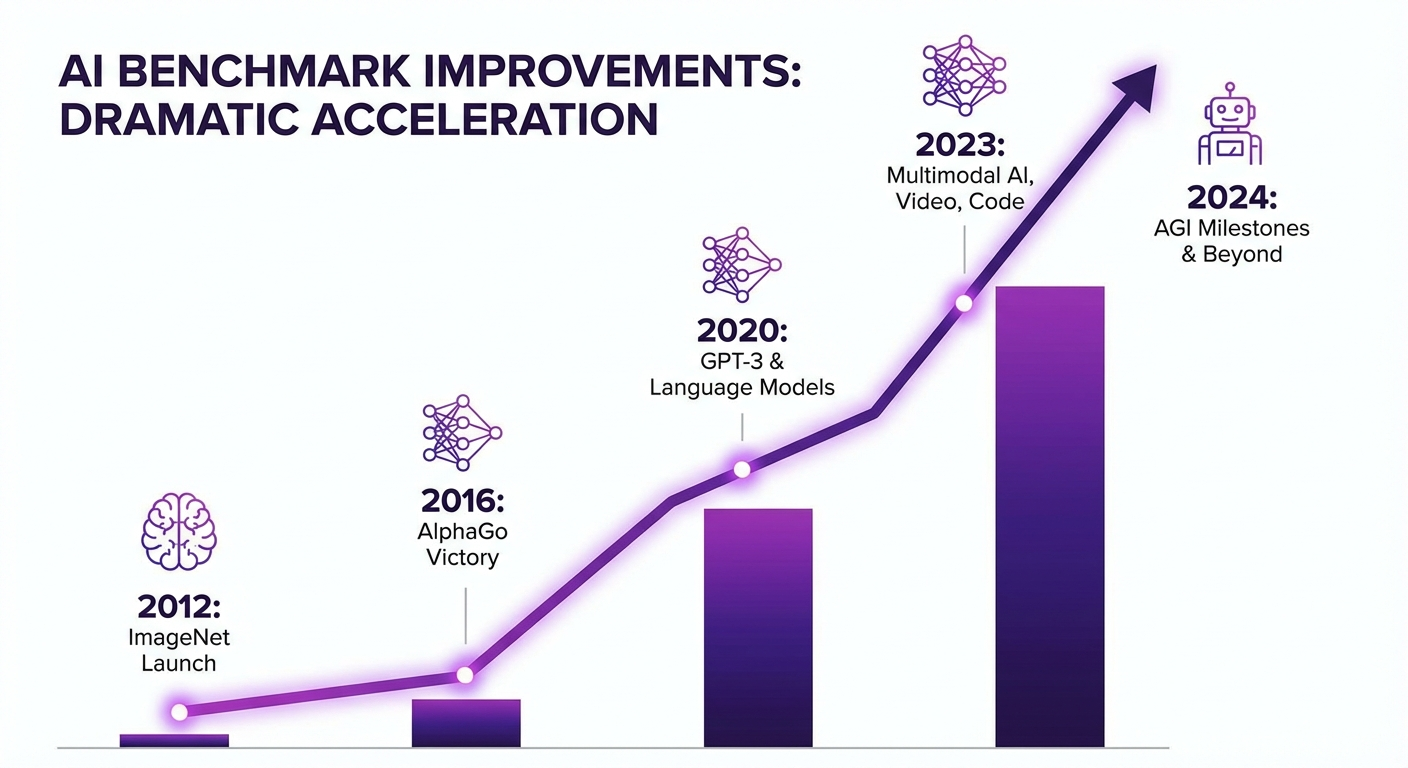
Other benchmarks tell similar stories. MMMU (Massive Multitask Multimodal Understanding) scores jumped 18.8 percentage points. GPQA (Graduate-level Google-Proof Q&A) improved by 48.9 points. These aren’t incremental gains — they represent qualitative shifts in what AI systems can do. And here’s the truly consequential finding: nearly 90% of notable AI models in 2024 came from industry, up from 60% in 2023. The era of academic AI leadership is effectively over.
Perhaps most significant for the competitive landscape is the frontier tightening. The performance gap between the top-ranked model and the 10th-ranked model shrank from 11.9% to just 5.4% in one year, with the top two models separated by only 0.7%. This compression means the AI market is heading toward commodity territory faster than anyone predicted.
What This Means for Business
Frontier tightening changes the strategic calculus entirely. When the top 10 AI models perform within 5% of each other, your competitive advantage doesn’t come from which model you choose — it comes from how you integrate AI into your workflows, data, and customer experience. Stop chasing the “best” model and start investing in the orchestration layer. Additionally, the benchmarking crisis — where improvements outpace measurement — suggests that traditional vendor evaluation methods are already obsolete. Businesses need to develop internal, domain-specific evaluation frameworks to truly assess AI value. Browse our interactive library for more AI research transformed into engaging experiences.
Turn your AI strategy documents and research reports into interactive experiences your team will actually engage with.
4. The Cost Revolution — 280x Cheaper AI in 18 Months
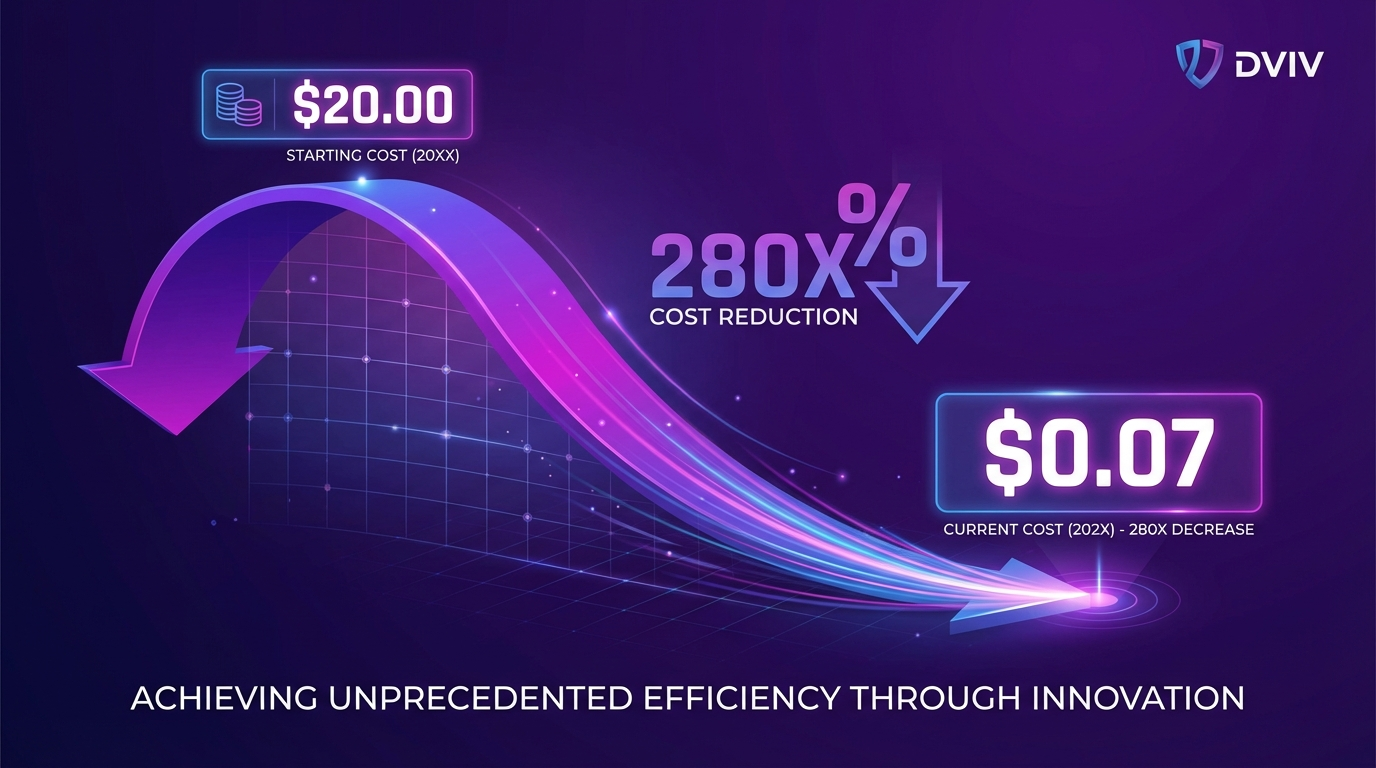
If there’s a single data point from the Stanford AI Index Report 2025 that should reshape your AI strategy, it’s this: the cost of achieving GPT-3.5-level AI performance dropped from $20 per million tokens to $0.07 per million tokens between November 2022 and October 2024. That’s a 280-fold reduction in just 18 months — a cost curve steeper than almost anything in the history of technology.
This isn’t happening in isolation. These artificial intelligence statistics from the AI industry report reveal that AI hardware costs are declining roughly 30% annually, while energy efficiency is improving 40% per year. Training compute is doubling every five months, datasets every eight months, and power usage annually. The exponential curve isn’t just in performance — it’s in the economics of deploying AI at scale.
The open-source revolution is amplifying this effect. Open-weight models have closed the performance gap with proprietary models from 8% to just 1.7%. When near-frontier performance is available for free, the barriers to entry for AI-powered businesses collapse. A startup today can access AI capabilities that would have cost millions just two years ago, for essentially nothing.
What This Means for Business
The 280x cost reduction is the most underreported story in AI. It means that every AI project your team shelved in 2023 because the economics didn’t work deserves a second look. Use cases that had negative ROI at $20 per million tokens become transformative at $0.07. For SMBs and startups, this is an unprecedented opportunity: you can now compete with enterprises on AI capability at a fraction of the cost. The moat isn’t access to AI anymore — it’s proprietary data and domain-specific workflows. Discover how Libertify’s solutions help businesses transform complex AI documentation into actionable interactive experiences.
5. The Global AI Race — US Leads, China Closes In
The geopolitical dimension of AI development has never been more consequential, and no AI industry report captures this better than the latest state of AI 2025 analysis. The Stanford AI Index Report 2025 paints a picture of clear US dominance in AI model development — 40 notable AI models originated from the United States in 2024, compared to China’s 15 and Europe’s 3. But dominance in model creation doesn’t tell the full story.
China leads the world in both AI publications and patents, building the research foundation for future capability leaps. And the quality gap is closing fast — the performance difference between top US and Chinese AI models shrank from double digits to near parity in 2024. China’s strategy of massive government investment (including a $47.5 billion semiconductor fund) combined with a vast domestic market for AI applications is producing results that pure model counts don’t capture.
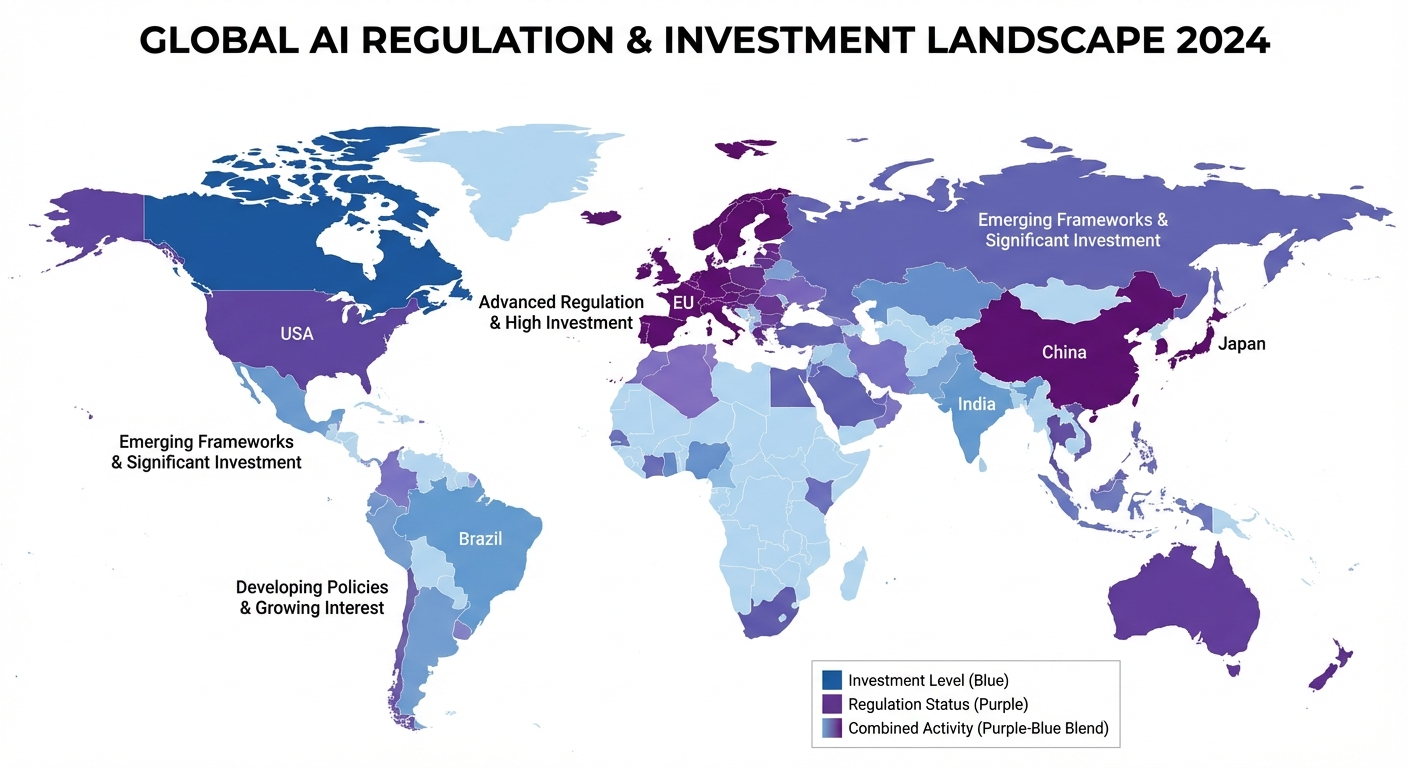
The investment race extends far beyond the US-China axis. Saudi Arabia’s $100 billion Project Transcendence, France’s €109 billion AI commitment, and similar mega-investments from Canada ($2.4B), India ($1.25B), and others signal that governments worldwide view AI leadership as a matter of national security and economic competitiveness. Europe’s mere 3 notable models in 2024 — despite massive investment pledges — underscores the challenge of converting capital into frontier AI capability.
What This Means for Business
For international businesses, the fragmenting AI landscape creates both risk and opportunity. Supply chain dependencies on AI chips (overwhelmingly manufactured with US-allied technology) could become strategic vulnerabilities. Companies operating across borders need to plan for a world where AI regulations, capabilities, and even the models available differ significantly by region. The China convergence story also means that Chinese AI-powered competitors will increasingly match Western companies on technical capability — differentiation will come from product, distribution, and trust.
6. AI in Healthcare & Science — From Lab to Life
The Stanford AI Index Report 2025 documents AI’s transition from laboratory curiosity to clinical reality in healthcare and science. The most striking acceleration is in FDA-approved AI-enabled medical devices: from just 6 approvals in 2015 to 223 in 2023. This 37x increase reflects not just improved AI performance, but growing regulatory confidence in AI-assisted medicine.

The clinical results are equally remarkable. In diagnostic accuracy studies, GPT-4 alone achieved 92% diagnostic accuracy — compared to 76% for physicians using GPT-4 as an assistant and 74% for traditional diagnostic methods. The finding is provocative: the AI outperformed the human-AI collaboration, suggesting that the integration challenge may be more important than the technology challenge.
Beyond diagnostics, AI is accelerating scientific discovery itself. The report highlights autonomous AI research labs capable of designing novel nanobodies — a process that previously required months of human researcher time. In the physical world, Waymo now operates more than 150,000 autonomous rides per week, and Baidu’s Apollo Go is expanding rapidly across Chinese cities. Industrial robotics installations reached 541,000 units globally in 2023, roughly triple the 2013 figure.
The ultimate validation came from the global scientific community itself: two Nobel Prizes in 2024 — in Physics (for foundational neural network work by Hopfield and Hinton) and Chemistry (for AI-driven protein structure prediction) — along with a Turing Award for reinforcement learning pioneers.
What This Means for Business
Healthcare, life sciences, and advanced manufacturing are entering a period of AI-driven disruption comparable to the internet’s impact on media and retail. The FDA approval trajectory suggests that regulatory barriers are falling, not rising. Companies in these sectors should be actively piloting AI-assisted workflows today — not in 2027. The GPT-4 diagnostic finding also contains a broader lesson: AI implementation isn’t just about buying technology. It’s about redesigning workflows to leverage AI’s strengths rather than simply bolting it onto existing human processes.
Make your healthcare AI research and compliance documents engaging. Transform PDFs into interactive experiences stakeholders actually read.
7. The Risk Equation — Incidents Up 56%, Trust Down
For every optimistic finding in the Stanford AI Index Report 2025, there’s a sobering counterbalance. AI-related incidents hit a record 233 in 2024 — a 56.4% increase over 2023, according to the AI Incident Database. These aren’t theoretical risks — they include real-world failures in autonomous systems, biased algorithmic decisions, privacy breaches, and harmful AI-generated content that affected real people and real businesses.
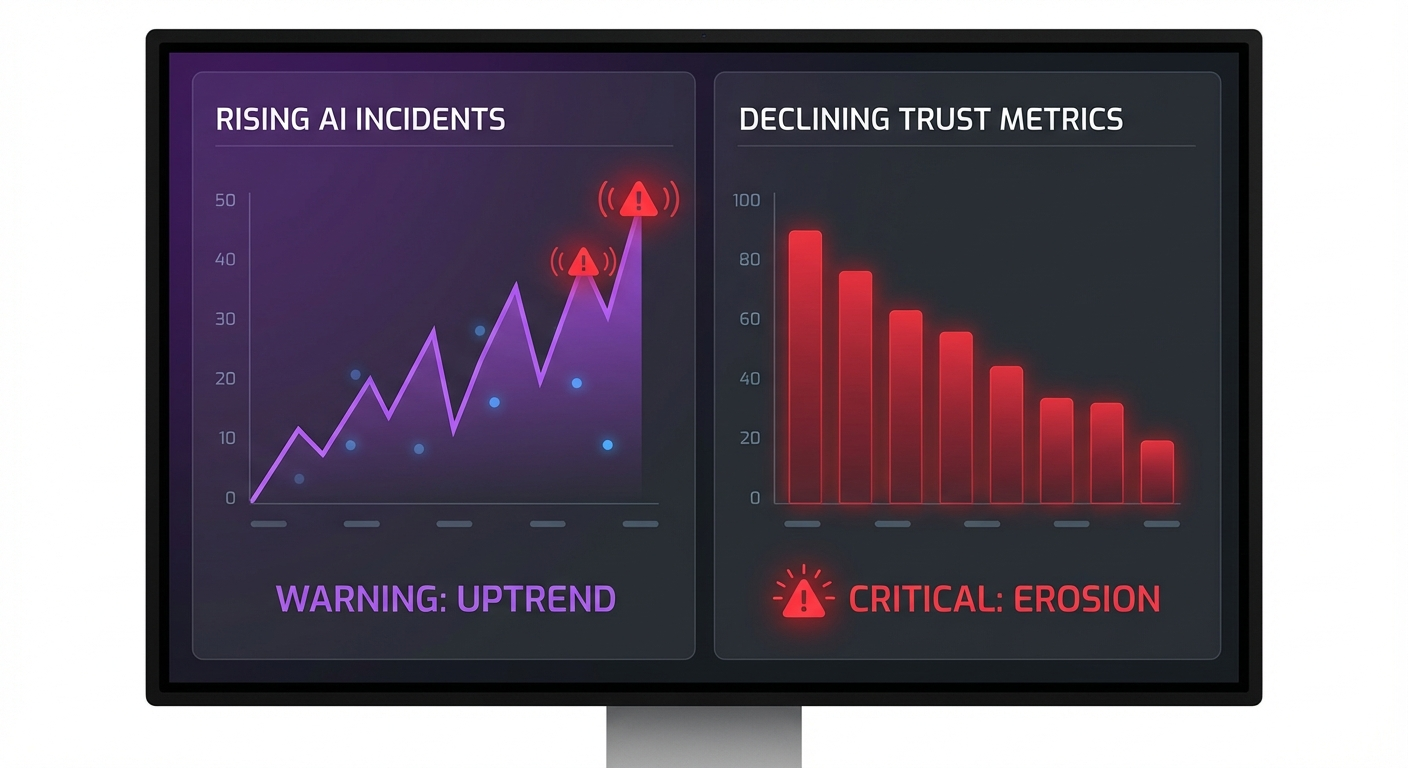
Public sentiment reflects this growing concern. Trust in AI companies to protect personal data fell from 50% to 47% between 2023 and 2024. While that may seem like a modest decline, it represents a continuation of a downward trend that should alarm any business building on AI. Consumer trust is the foundation of adoption, and it’s eroding.
The data access landscape is shifting dramatically as well. Websites blocking AI scraping jumped from 5-7% to 20-33% of common crawl content in 2024. Publishers, platforms, and content creators are actively restricting the data that AI models depend on, creating potential bottlenecks for future model training and raising legal questions about existing models trained on now-restricted data.
Regulators are responding at unprecedented speed. US federal agencies introduced 59 AI-related regulations in 2024 — double the 2023 count, from twice as many agencies. Globally, legislative mentions of AI increased 21.3% across 75 countries since 2023, and have risen 9x since 2016. The EU AI Act is entering its implementation phase, establishing the world’s first comprehensive AI regulatory framework. For a deeper breakdown of the EU AI Act’s implications, explore our interactive guide to the EU AI Act.
Perhaps the most fascinating finding is the global sentiment divide. In Indonesia, 80% of respondents see AI as more beneficial than harmful. In China, it’s 83%. In Thailand, 77%. But in the United States, only 39% share that optimism — and Canada sits at just 40%. The nations building AI are increasingly skeptical of it, while nations consuming AI are enthusiastic. This divergence has profound implications for market strategy and product positioning.
What This Means for Business
The risk data makes one thing clear: responsible AI is no longer a nice-to-have — it’s a competitive moat. With incidents up 56%, trust declining, and regulation accelerating, companies that build robust AI governance frameworks now will have a structural advantage over those scrambling to comply later. The sentiment divide also creates strategic opportunity: AI products marketed in Southeast Asia can lean into capability and optimism, while Western-market positioning should lead with safety, transparency, and control. For 80.4% of US local policymakers who support stricter data privacy rules, the regulatory ratchet will only tighten.
8. Stanford AI Index Report 2025: What Business Leaders Should Do Now
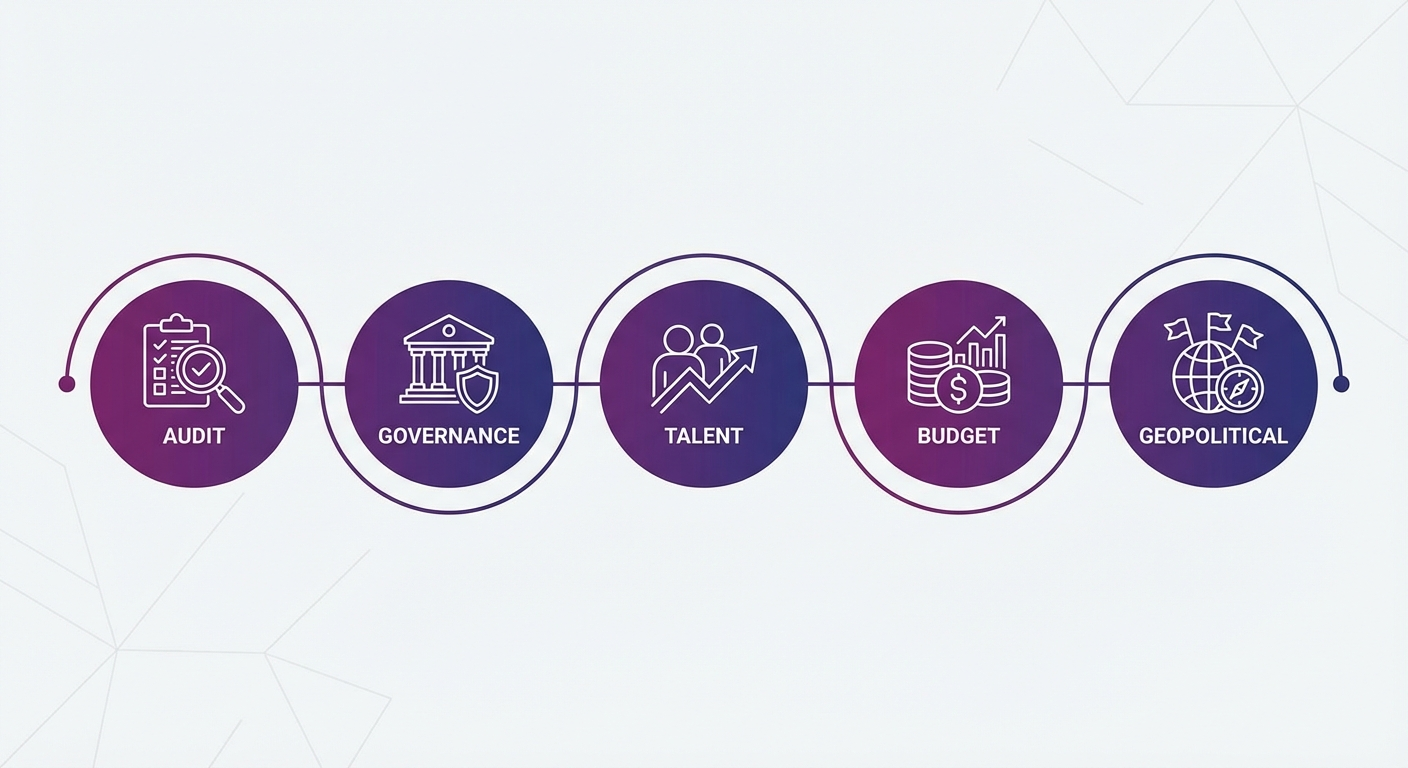
The Stanford AI Index Report 2025 isn’t just a snapshot of where AI stands — it’s a blueprint for strategic action. Based on the data, here are five concrete steps every business leader should take in the next 90 days.
1. Conduct an Honest AI Readiness Audit
With 78% of organizations now using AI, the adoption threshold has passed. If you’re in the remaining 22%, you’re not cautious — you’re behind. But even if you are using AI, the question is whether you’re using it strategically or experimentally. Audit your current AI deployments against business outcomes, not technology metrics. Map every function — from customer service to supply chain — and identify where AI could generate measurable ROI.
2. Reassess AI Budgets with 280x Cost Reductions
Every AI business case from 2023 is outdated. The 280x cost reduction in inference means that projects previously dismissed as too expensive may now be your highest-ROI opportunities. Revisit your AI roadmap with current pricing. Evaluate open-weight models (now within 1.7% of frontier performance) as alternatives to expensive proprietary APIs. The economics have fundamentally shifted — your budget assumptions should too.
3. Build AI Governance Before Regulators Force It
With 59 new US federal regulations in 2024, the EU AI Act entering force, and global legislative activity accelerating, reactive compliance will be expensive and disruptive. Companies that establish AI governance frameworks now — covering model evaluation, bias testing, incident response, and data provenance — will spend less, move faster, and earn greater stakeholder trust than those who wait for mandates.
4. Invest in AI-Native Talent and Education
The Stanford report reveals that 81% of K-12 teachers believe AI should be part of foundational computer science education, but fewer than 50% feel equipped to teach it. This gap translates directly into a workforce pipeline problem. Companies that invest in upskilling programs, AI literacy training, and partnerships with educational institutions will have first access to the talent that every organization will need.
5. Develop a Geopolitical AI Risk Strategy
The US-China dynamics documented in the report — from chip supply chains to model performance convergence — create real operational risks for businesses. Review your AI supply chain dependencies: which models do you rely on? Where are your AI chips manufactured? What happens if export controls tighten further? Companies with diversified AI infrastructure — spanning multiple model providers, cloud platforms, and geographic jurisdictions — will be most resilient.
The Stanford AI Index Report 2025 makes one thing unmistakably clear: the companies that thrive in the AI era won’t be those with the best technology. They’ll be the ones that move fastest to integrate AI into their strategy, governance, and culture — while the artificial intelligence statistics and AI trends 2025 data still gives them time to lead rather than follow.
Transform this report and your strategic documents into interactive experiences your board and team will actually engage with.
Frequently Asked Questions
What are the key findings of the Stanford AI Index Report 2025?
The Stanford AI Index Report 2025 reveals that total corporate AI investment reached $252.3 billion in 2024 (up 26% year-over-year), AI inference costs dropped 280x in 18 months, 78% of organizations now use AI (up from 55% in 2023), AI incidents surged 56.4% to a record 233 incidents, and AI performance on major benchmarks like SWE-bench jumped from 4.4% to 71.7% in a single year.
How much did global AI investment grow in 2024?
Global corporate AI investment reached $252.3 billion in 2024, representing 26% year-over-year growth. US private AI investment led at $109.1 billion — nearly 12 times China’s $9.3 billion. Generative AI specifically attracted $33.9 billion in private investment, an 18.7% increase from 2023 and 8x the 2022 total.
How much have AI costs decreased according to the Stanford AI Index 2025?
AI inference costs have dropped 280-fold in just 18 months. GPT-3.5-level performance that cost $20 per million tokens in November 2022 dropped to just $0.07 per million tokens by October 2024. Additionally, AI hardware costs are declining 30% annually while energy efficiency improves 40% per year.
Which countries lead in AI development in 2025?
The United States leads in AI model development, producing 40 notable AI models in 2024 compared to China’s 15 and Europe’s 3. US private AI investment ($109.1B) dwarfs all competitors. However, China leads in AI publications and patents, and the performance gap between US and Chinese models has narrowed from double digits to near parity.
What are the biggest AI risks identified in the Stanford AI Index Report 2025?
The report identifies several escalating risks: AI-related incidents hit a record 233 in 2024 (56.4% increase over 2023), public trust in AI companies fell from 50% to 47%, websites blocking AI data scraping jumped from 5-7% to 20-33%, and 59 new AI regulations were introduced by US federal agencies alone — double the 2023 count.